




Gynecologic Oncology
Latest News
Advertisement
Latest Videos





CME Content































Advertisement
More News
Gaining Ground in Gynecologic and Hematologic Cancers at ASCO 2023: Drs Herrera, Westin, and Jabbour
OncLive® will be LIVE with OncLive® News Network: On Location at the 2023 ASCO Annual Meeting. Each day, we will broadcast a series of interviews with top thought leaders, to learn their thoughts and reactions to data presented across hematologic oncology during the conference.

Dostarlimab maintained the health-related quality of life in patients with primary advanced or recurrent endometrial cancer.

Mirvetuximab soravtansine-gynx demonstrated a 35% reduction in the risk of disease progression or death compared with investigator’s choice of chemotherapy in patients with folate receptor alpha-high, platinum-resistant ovarian cancer.

The combination of dostarlimab with standard-of-care carboplatin and paclitaxel elicited a statistically significant and clinically meaningful improvement in progression-free survival vs carboplatin/paclitaxel plus placebo in patients with mismatch repair–deficient/microsatellite instability–high advanced or recurrent endometrial cancer.

Simple hysterectomy was found to be noninferior to radical hysterectomy and pelvic node dissection in patients with low-risk, early-stage cervical cancer, according to results of the Canadian Cancer Trials Group CX.5/SHAPE trial.

Eugenia Girda, MD, FACOG, discusses the use of pembrolizumab plus chemotherapy for patients with endometrial cancer as seen in the phase 3 NRG-GY018 trial.

The combination of durvalumab and platinum-based chemotherapy, followed by maintenance therapy with either durvalumab plus olaparib or durvalumab alone, elicited a statistically significant and clinically meaningful improvement in progression-free survival in patients with newly diagnosed, advanced or recurrent endometrial cancer.

Pembrolizumab plus chemotherapy with or without bevacizumab led to a substantial improvement in overall survival vs placebo plus chemotherapy with or without bevacizumab in patients with persistent, recurrent, or metastatic cervical cancer, according to the final OS analysis of the KEYNOTE-826 trial.

Bhavana Pothuri, MD, expands on challenges that still need to be addressed for the treatment of patients with endometrial cancer, highlights potential practice-changing data from the phase 3 NRG-GY018 and RUBY trials, details the evolving role of PARP inhibitors for patients with ovarian cancer, and touches on key emerging data from trials for patients with cervical cancer.

The National Institute for Health and Care Excellence has recommended the combination of pembrolizumab and lenvatinib for use in previously treated patients with advanced or recurrent endometrial cancer whose cancer has progressed on or after platinum-based chemotherapy and who cannot have curative surgery or radiotherapy.

For the 11th consecutive year, OncLive is honored to recognize oncology leaders whose innovations have contributed to immeasurable improvements in outcomes for countless patients.

R. Wendel Naumann, MD, FACOG, FACS, discusses how the evolution of immunotherapy has changed the treatment landscape for patients with recurrent or metastatic cervical cancer.

The European Medicines Agency has validated a type II variation for potential approval of dostarlimab in combination with carboplatin and paclitaxel for the treatment of patients with mismatch repair–deficient/microsatellite instability–high primary advanced or recurrent endometrial cancer.

Joshua G. Cohen, MD, FACOG, FACS, expands on the role of PARP inhibitors in the recurrent and up-front settings in ovarian cancer, and the clinical significance of the RUBY and NY-GY018 trials in endometrial cancer.

The combination of the potentially first-in-class off-the-shelf therapeutic cancer vaccine candidate VB10.16 and atezolizumab elicited a median overall survival greater than 25 months in patients with PD-L1–positive, human papillomavirus 16–positive advanced cervical cancer.

A deep learning risk prediction model was able to accurately identify patients with endometrial cancer at low and high risk of distant recurrence, according to data presented during the 2023 AACR Annual Meeting.

Fewer Americans are aware of the fact that the human papillomavirus can cause certain types of cancer, and vaccination rates against the virus are lagging, according to recent research presented at the AACR Annual Meeting 2023.
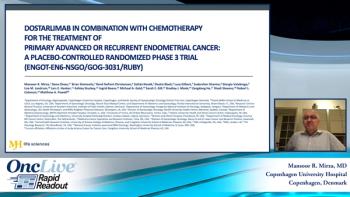
Mansoor R. Mirza, MD, reviews data from the phase 3 RUBY trial investigating dostarlimab in combination with carboplatin and paclitaxel for the treatment of primary advanced or recurrent endometrial cancer.

Trastuzumab Deruxtecan Displays Antitumor Activity, Safety in HER2-Expressing Uterine Carcinosarcoma
The antibody-drug conjugate trastuzumab deruxtecan led to durable responses and a tolerable safety profile in patients with HER2-expressing uterine carcinosarcoma.

Shannon N. Westin, MD, MPH, FACOG, shares preclinical data that provided the impetus for the SOLAR trial of olaparib and selumetinib in patients with RAS-mutated gynecologic cancers, key findings from the dose-escalation and -expansion portions of the research, and next steps with the combination.

Amanda Nickles Fader, MD, discusses the randomized, phase 3 NRG-GY019 trial evaluating letrozole with or without paclitaxel and carboplatin in patients with stage II to IV primary low-grade serous carcinoma of the ovary or peritoneum.

Brian M. Slomovitz, MD, discusses the classification of molecular subtypes to guide treatment and care in endometrial cancers.

Han T. Cun, MD, MS, discusses the findings from a retrospective comprehensive molecular classification of patients with grade 3 endometrioid endometrial adenocarcinoma.

Dr Gilbert discusses the FDA approval of dostarlimab in patients with endometrial cancer, key efficacy data from the GARNET trial, and how this agent bolsters the endometrial cancer treatment paradigm.

Marilyn Huang, MD, contextualizes findings within the endometrial cancer treatment landscape and emphasizes the unanswered questions regarding optimal therapies for patients with mismatch repair–proficient disease.
Advertisement
Advertisement
Trending on OncLive
1
Long-Term Cilta-Cel Data Show Low Rates of PFS Events in Standard-Risk R/R Myeloma
2
FDA Updates Axi-Cel Label to Remove Limitation of Use in R/R PCNSL
3
Real-World Data Support Clinical Benefit With Lifileucel in Previously Treated Advanced Melanoma
4
Single-Center, Retrospective Data Show Low Rate of Lifileucel Infusion Following Referral in Advanced Melanoma
5