







Gynecologic Oncology
Latest News
Advertisement
Latest Videos








CME Content































Advertisement
More News

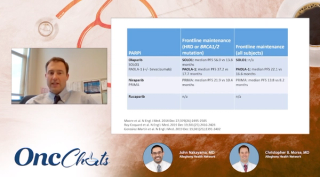
Ritu Salani, MD, discusses the development of ADCs, the potential role of selinexor, and the use of PARP inhibitors across endometrial cancer subsets.

Bhavana Pothuri, MD, discusses real-world testing patterns for MMR/MSI status in patients with advanced endometrial cancer.
Ritu Salani, MD, discusses the role of ADCs in ovarian cancer and what the future of the post-IO setting in cervical cancer management may look like.

Krishnansu S. Tewari, MD, discusses the FDA approval of dostarlimab plus chemotherapy for patients with primary advanced or recurrent endometrial cancer.

Laura J. Chambers, DO, discusses the role of genetic testing and PARP inhibitor maintenance therapy for patients with ovarian cancer.

Treatment with sacituzumab govitecan led to antitumor activity in endometrial cancer and TROP-2 expression did not appear to affect response to the agent.

Durvalumab plus chemotherapy, then durvalumab with or without olaparib, was approved in Europe for select advanced/recurrent endometrial cancer.

Shannon Westin, MD, MPH, FACOG, discusses the FDA approval of durvalumab plus chemotherapy in dMMR advanced or recurrent endometrial cancer.
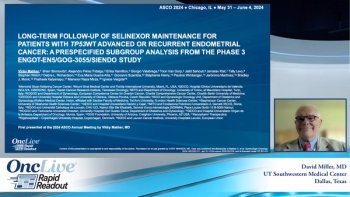
David Miller, MD, reviews a plenary presentation (originally presented at the ASCO 2024 Annual Meeting by Vikky Makker, MD) on the long-term follow-up of the ENGOT-EN5/GOG-3055/SIENDO trial, focusing on selinexor maintenance for patients with TP53 wild-type advanced or recurrent endometrial cancer.

The FDA has approved dostarlimab plus carboplatin and paclitaxel, followed by single-agent dostarlimab, for primary advanced or recurrent endometrial cancer.

In case you missed any, below is a recap of every OncLive On Air episode that aired in July 2024.

Health Canada has granted full approval to dostarlimab monotherapy for patients with recurrent or advanced dMMR/MSI-H endometrial cancer.

Bintrafusp alfa elicited responses in patients with recurrent/metastatic cervical cancer, warranting further exploration of TGF-β-targeted therapies.

Maurie Markman, MD, discusses an analysis of the association between obesity and the development of endometrial cancer.

Here is your guide to the important regulatory decisions made by the FDA in June 2024.

Dostarlimab plus chemotherapy demonstrated a meaningful overall survival improvement in primary endometrial cancer, regardless of mismatch repair status.

Salman R. Punekar, MD discusses the rationale for evaluating safety and preliminary anti-tumor activity of NT-112 in solid tumors with the KRAS G12D mutation.

The EMA recommends durvalumab plus chemotherapy, followed by olaparib and durvalumab for pMMR endometrial cancer, and single-agent durvalumab for dMMR disease.

Bhavana Pothuri, MD, discusses real-world treatment patterns and outcomes in patients with advanced endometrial cancer according to MMR/MSI status.

David M. O’Malley, MD, and Chandler H. Park, MD, FACP, discuss updates in gynecologic oncology at the 2024 ASCO Annual Meeting.

Dostarlimab/chemotherapy/niraparib elicited favorable PFS outcomes across several subgroups in primary advanced or recurrent endometrial cancer.

First-line rucaparib maintenance therapy maintained a PFS benefit vs placebo at 4 years of follow-up in newly diagnosed advanced ovarian cancer.

An expanded indication for dostarlimab plus chemotherapy for all adult patients with primary advanced or recurrent endometrial cancer is under EMA review.

First-line lenvatinib plus pembrolizumab demonstrated antitumor activity across various histologic subtypes in advanced or recurrent endometrial cancer.

ROCSAN step 1 did not meet its primary end point of 16-week response rate with niraparib or dostarlimab/niraparib in endometrial/ovarian carcinosarcoma.
Advertisement
Advertisement
Trending on OncLive
1
Long-Term Cilta-Cel Data Show Low Rates of PFS Events in Standard-Risk R/R Myeloma
2
FDA Updates Axi-Cel Label to Remove Limitation of Use in R/R PCNSL
3
Real-World Data Support Clinical Benefit With Lifileucel in Previously Treated Advanced Melanoma
4
Single-Center, Retrospective Data Show Low Rate of Lifileucel Infusion Following Referral in Advanced Melanoma
5