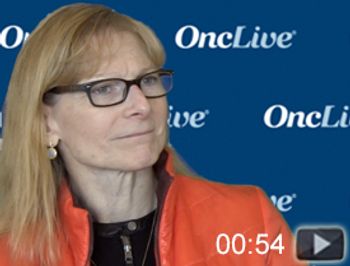
Prudence Francis, MD, Peter MacCallum Cancer Centre, discusses ovarian suppression in young women with hormone receptor (HR)-positive breast cancer.

Your AI-Trained Oncology Knowledge Connection!


Prudence Francis, MD, Peter MacCallum Cancer Centre, discusses ovarian suppression in young women with hormone receptor (HR)-positive breast cancer.

Sagus Sampath, MD, assistant professor, Department of Radiation Oncology, City of Hope, discusses the safety profile of immunotherapy in combination with radiation in the treatment of patients with lung cancer.

Masatoshi Kudo, MD, PhD, Department of Gastroenterology and Hepatology, Kindai University, discusses the randomized phase II trial comparing transarterial chemoradiation (TACE) plus sorafenib (Nexavar) with TACE alone in patients with hepatocellular carcinoma (HCC).

John L. Marshall, MD, chief, Division of Hematology/Oncology, Medstar Georgetown University Hospital director, Otto J. Ruesch Center for the Cure of Gastrointestinal Cancer, Georgetown-Lombardi Comprehensive Cancer Center, discusses the progression of immunotherapy in colon cancer.

David R. Wise, MD, PhD assistant professor in the Department of Medicine, assistant professor, Department of Urology, NYU Langone's Perlmutter Cancer Center, discusses the FDA approval of apalutamide (ARN-509) for the treatment of patients with non-metastatic castration-resistant prostate cancer (CRPC).

Frederick Locke, MD, a medical oncologist in the Department of Blood and Marrow Transplant at Moffitt Cancer Center, and an assistant professor of Oncology at the University of South Florida, discusses the impact of the ZUMA-1 trial for patients with non-Hodgkin Lymphoma (NHL).

Tanios Bekaii-Saab, MD, professor of medicine, Mayo Clinic, discusses the importance of the phase II regorafenib (Stivarga) dose optimization study (ReDOS) in metastatic colorectal cancer (mCRC).

Brian T. Hill, MD, PhD, assistant professor, Hematology and Oncology, Cleveland Clinic, discusses BTK inhibitors in mantle cell lymphoma (MCL).

Claudine Isaacs, MD, professor, medical director, Fisher Center for Familial Cancer Research, co-director, Breast Cancer Program, Georgetown University/Lombardi Cancer Center, discusses the future of treatment for patients with HER2-positive breast cancer.

Ian Flinn, MD, director of the Blood Cancer Research Program, Sarah Cannon Research Institute, discusses the toxicities associated with the combination of venetoclax (Venclexta) and obinutuzumab (Gazyva) in chronic lymphocytic leukemia (CLL).

Allyson Ocean, MD, medical oncologist, attending physician, Gastrointestinal Oncology, Weill Cornell Medicine/NewYork-Presbyterian Hospital, medical oncologist, The Jay Monahan Center for Gastrointestinal Health, associate professor of medicine, Weill Medical College of Cornell University, discusses ongoing research on high-dose intravenous (IV) vitamin C in KRAS-mutated cells.

Tari King, MD, FACS, chief of Breast Surgery, Dana-Farber Cancer Institute, Brigham Women’s Cancer Center, discusses axillary node dissection in patients with breast cancer.

Lecia V. Sequist, MD, associate professor of medicine, Harvard Medical School, Mary B. Saltonstall Chair, Oncology, Massachusetts General Hospital Center, discusses combination regimens for patients with EGFR-positive non-small cell lung cancer (NCSLC).

Jia Ruan, MD, PhD, associate professor of clinical medicine, Weill Cornell Medicine/NewYork-Presbyterian Hospital, discusses long-term findings with lenalidomide (Revlimid) plus rituximab (Rituxan) in mantle cell lymphoma (MCL).

James K. McCloskey II, MD, medical oncologist, Division of Leukemia and the Adult Blood and Marrow Stem Cell Transplantation Program, John Theurer Cancer Center, discusses IDH inhibitors in acute lymphoblastic leukemia (AML).

David O'Malley, MD, a professor in the Department of Obstetrics and Gynecology at The Ohio State University Comprehensive Cancer Center, discusses the current role for PARP inhibitors for patients with ovarian cancer.

Bridget F. Koontz, MD, radiation oncologist, Duke Cancer Institute, discusses a phase II trial of 6 months of androgen deprivation therapy/abiraterone acetate (Zytiga) plus prednisone and definitive radiotherapy for men with intermediate- to high-risk localized prostate cancer.

Michael Pishvaian, MD, PhD, director, Phase I Clinical Program, co-director of the Ruesch Center Pancreatic Cancer Program Medical Oncology, Otto J. Ruesch Center for the Cure of Gastrointestinal Cancer, Georgetown-Lombardi Comprehensive Cancer Center, discusses the use of precision medicine, specifically molecular profiling in patients with gastrointestinal (GI) cancers.

Aiwu Ruth He, MD, PhD, associate professor of medicine, Georgetown-Lombardi Comprehensive Cancer Center, summarizes current treatment approaches in gastrointestinal (GI) cancers.

Saad Z. Usmani, MD, Department of Hematologic Oncology and Blood Disorders, Levine Cancer Institute/Carolinas HealthCare System, discusses molecular profiling in patients with multiple myeloma.

Elizabeth Plimack, MD, director of Genitourinary Clinical Research at Fox Chase Cancer Center, discusses recent trials in kidney cancer.

Benjamin P. Levy, MD, assistant professor of oncology, clinical director of medical oncology, Johns Hopkins Sidney Kimmel Cancer Center, Johns Hopkins Medicine, discusses pembrolizumab (Keytruda) in non-small cell lung cancer.

Joaquim Bellmunt, MD, PhD, associate professor of medicine, Harvard Medical School, director, Bladder Cancer Center, Dana-Farber Cancer Institute, discusses the combination of immunotherapy with IDO inhibitors for patients with urothelial carcinoma.

Andrew E. Hendifar, MD, medical oncology lead for the Gastrointestinal Disease Research Group, Cedars-Sinai Medical Center, discusses the future treatment landscape for patients with neuroendocrine tumors (NETs).

David Mutch, MD, Ira C. and Judith Gall professor, vice chair of obstetrics and gynecology, chief, Division of Gynecologic Oncology, Washington University School of Medicine, Siteman Cancer Center, discusses whether or not a patient with high-risk endometrial cancer should receive external beam radiation therapy.

Jonathan R. Strosberg, MD, associate professor, Moffitt Cancer Center, discusses the development of radiolabeled somatostatin analogs in the treatment of patients with gastroenteropancreatic neuroendocrine tumors (GEP-NETs).

Allyson Ocean, MD, medical oncologist, attending physician, Gastrointestinal Oncology, Weill Cornell Medicine/New York-Presbyterian Hospital, medical oncologist, The Jay Monahan Center for Gastrointestinal Health, associate professor of medicine, Weill Medical College of Cornell University, discusses emerging anti-stromal agents in pancreatic cancer.

Michael A. Morse, MD, professor, Medicine, Department of Surgery, Duke University School of Medicine, Duke Cancer Institute, discusses factors that should be taken into consideration when sequencing agents in metastatic colorectal cancer.

John L. Marshall, MD, chief, Division of Hematology/Oncology, Medstar Georgetown University Hospital director, Otto J. Ruesch Center for the Cure of Gastrointestinal Cancer, discusses the specificity now required in the treatment of patients with metastatic colorectal cancer (mCRC).

William R. Jarnagin, MD, FACS, chief, Hepatopancreatobiliary Service, Benno C. Schmidt Chair, Surgical Oncology, Memorial Sloan Kettering Cancer Center, discusses the progression of surgery in treating patients with metastatic colorectal cancer.