



Gastrointestinal Cancer
Latest News
Advertisement
Latest Videos






CME Content































Advertisement
More News

Michael Pishvaian, MD, PhD, director, Phase I Clinical Program, co-director of the Ruesch Center Pancreatic Cancer Program Medical Oncology, Otto J. Ruesch Center for the Cure of Gastrointestinal Cancer, Georgetown University Lombardi Comprehensive Cancer Center, discusses the background of a study investigating molecular alterations for patients with pancreatic cancer.
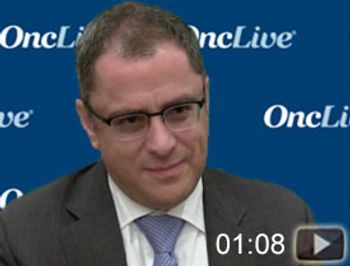
Ghassan K. Abou-Alfa, MD, medical oncologist, Memorial Sloan Kettering Cancer Center, discusses how the potential approval of cabozantinib (Cabometyx) in hepatocellular carcinoma (HCC) could affect the treatment landscape in liver cancer.

Arun S. Singh, MD, associate professor, UCLA David Geffen School of Medicine, discusses the future of immunotherapy in gastrointestinal stromal tumors (GIST).
William R. Jarnagin, MD, FACS, chief, Hepatopancreatobiliary Service, Benno C. Schmidt Chair, Surgical Oncology, Memorial Sloan Kettering Cancer Center, discusses the surgical barriers in treating patients with colorectal cancer that has metastasized outside of the liver.

Akihito Kawazoe, MD, discusses the study of napabucasin plus pembrolizumab in mCRC.
Robert Ramirez, DO, FACP, Ochsner Medical Center, discusses treating patients with neuroendocrine tumors (NETs) of the lung.

Arun S. Singh, MD, discusses the developing role of immunotherapy in patients with GISTs, particularly the randomized phase II trial investigating nivolumab as a single agent and in combination with ipilimumab.
Adel Kardosh, MD, postdoctoral medical fellow, oncology, Stanford Medicine, discusses epacadostat in gastric and gastroesophageal junction (GEJ) adenocarcinoma.
Andrew Zhu, MD, PhD, director, Liver Cancer Research, Medicine, Massachusetts General Hospital, discusses the findings of KEYNOTE-224 in hepatocellular carcinoma (HCC).
Thomas Karasic, MD, investigator at Penn Medicine, discusses the rationale behind the phase II trial (NCT01037790) of palbociclib (Ibrance) in patients with advanced esophageal or gastric cancer.

Michael J. Pishvaian, MD, PhD, discusses the findings with entrectinib in this population, as well as the potential implications of widespread molecular testing in pancreatic cancer.
Yelena Y. Janjigian, MD, medical oncologist, Memorial Sloan Kettering Cancer Center, discusses the role of immunotherapy for patients with gastric and esophageal cancer.

The FDA has approved Lutathera for the treatment of patients with somatostatin receptor-positive gastroenteropancreatic neuroendocrine tumors.
Arun S. Singh, MD, Ronald Reagan UCLA Medical Center, discusses the rationale behind a randomized phase II study (NCT02880020) of nivolumab (Opdivo) monotherapy versus nivolumab with ipilimumab (Yervoy) in patients with metastatic or unresectable gastrointestinal stromal tumors (GIST).
Thierry Andre, MD, professor of medical oncology, University Pierre et Marie Curie (UMPC), and Head of the Medical Oncology Department in St. Antoine Hospital, Assistance Publique Hôpitaux de Paris, discusses the results of the combination of nivolumab (Opdivo) plus ipilimumab (Yervoy) in patients with DNA mismatch repair-deficient/microsatellite instability-high metastatic colorectal cancer.

Radiofrequency ablation was associated with superior 5-year overall survival compared with stereotactic body radiotherapy for patients with localized hepatocellular carcinoma.
Data from the CheckMate-142 study support the use of nivolumab (Opdivo) alone or in combination with ipilimumab (Yervoy) for the treatment of patients with previously treated DNA mismatch repair-deficient/microsatellite instability-high metastatic colorectal cancer.
Michael J. Overman, MD, associate professor, department of Gastrointestinal Medical Oncology, The University of Texas MD Anderson Cancer Center, discusses nivolumab (Opdivo) in patients with DNA mismatch repair-deficient/microsatellite instability-high metastatic CRC.
Older patients with colorectal cancer are more likely to develop cardiovascular disease and congestive heart failure, according to results from an analysis of the SEER database.
Combining the investigational oral cancer stem cell pathway inhibitor napabucasin with the PD-1 inhibitor pembrolizumab showed a signal of efficacy in the first 8 patients enrolled in a multicenter phase I/II trial of patients with metastatic colorectal cancer.
Ian Chau, MD, consultant medical oncologist, Royal Marsden Hospital, discusses the tolerability of ramucirumab (Cyramza) plus pembrolizumab (Keytruda) in gastric or gastroesophageal (GEJ) cancer.
Tanios Bekaii-Saab, MD, professor of medicine, Mayo Clinic, discusses the quality of life findings for a dose-escalation study of regorafenib (Stivarga) in metastatic colorectal cancer.
David H. Ilson, MD, PhD, medical oncologist, Memorial Sloan Kettering Cancer Center, discusses a trial from Germany comparing standard perioperative ECF/ECX chemotherapy with a regimen combining 5-FU (5-fluorouracil) with oxaliplatin and docetaxel.

Treatment with the PD-1 inhibitor pembrolizumab elicited promising progression-free survival and overall survival results in patients with advanced hepatocellular carcinoma who received previous treatment with sorafenib.

The combination of cetuximab and pembrolizumab was found to be well tolerated in patients with RAS wild-type metastatic colorectal cancer.
Advertisement
Advertisement
Trending on OncLive
1
Long-Term Cilta-Cel Data Show Low Rates of PFS Events in Standard-Risk R/R Myeloma
2
Real-World Data Support Clinical Benefit With Lifileucel in Previously Treated Advanced Melanoma
3
FDA Updates Axi-Cel Label to Remove Limitation of Use in R/R PCNSL
4
Single-Center, Retrospective Data Show Low Rate of Lifileucel Infusion Following Referral in Advanced Melanoma
5