






Gastrointestinal Cancer
Latest News
Advertisement
Latest Videos

CME Content

































Advertisement
More News

Patients with advanced esophagogastric adenocarcinoma who received docetaxel as a second-line therapy experienced a longer period of overall survival as well as a better quality of life compared with patients who received active symptom control.

A retrospective analysis of the potential benefits of surgery following treatment with imatinib (Gleevec) suggests a clear benefit in both OS and PFS in patients with metastatic or recurrent GIST when compared with those who received imatinib therapy alone.

A combination of maintenance bevacizumab plus standard second-line chemotherapy appears to be an effective strategy in managing patients with metastatic colorectal cancer after disease progression

Randall F. Holcombe, MD, Tisch Cancer Institute at Mount Sinai Medical Center, speaks about the use of aflibercept in patients with metastatic colorectal cancer.

For Johns Hopkins' gastrointestinal cancer surgeon Mark Duncan, MD, those who help his patients to cope with their diagnosis and manage their often complex treatment and follow-up are critical members of the healthcare team.

Matthew H.G. Katz, MD, from the MD Anderson Cancer Center, discusses borderline resectable pancreatic ductal adenocarcinoma, a newer stage of pancreatic cancer introduced by the NCCN in 2003.

The prognosis for patients with colorectal cancer has benefited greatly from the advent of advances in chemotherapy and new agents, with nearly threefourths of stage I patients surviving for at least 5 years after diagnosis.

Researchers have identified a potential predictive marker for survival in cases of metastatic colorectal cancer (mCRC) treated with bevacizumab (Avastin), suggesting that patients who have the appropriate biomarker could experience a greater benefit when given the drug, whereas others who do not express the biomarker could be spared from receiving unnecessary therapy.

For Johns Hopkins' gastrointestinal cancer surgeon Mark D. Duncan, those who help his patients cope with their diagnosis and manage their often complex treatment and follow-up are critical members of the healthcare team.
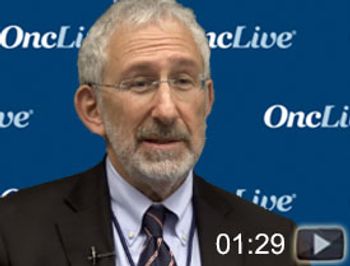
Targeted antineoplastic therapy based on the presence of a well-defined molecular target should be recognized as a standard-of-care approach in an increasing number of clinical settings.

Randall F. Holcombe, MD, from the Tisch Cancer Institute at Mount Sinai Medical Center, discusses the oral multikinase inhibitor regorafenib for patients with metastatic colorectal cancer.
Researchers have identified a potential predictive marker for survival in cases of metastatic colorectal cancer treated with bevacizumab.

Computer-aided computed tomographic colonography that does not require a laxative preparation nearly rivals conventional optical colonoscopy for identifying asymptomatic adults with adenomas.

Nancy L. Lewis, MD, from the Thomas Jefferson University Hospitals, discusses the phase III CORRECT trial that examined the multitargeted tyrosine kinase inhibitor regorafenib.
Patients 75 years of age or older with stage III colon cancer may expect a survival benefit from adjuvant chemotherapy that rivals that previously reported in younger patients.

Regorafenib significantly delays disease progression in virtually all subgroups of patients with GIST in the second-line setting, and may even confer benefits when continued after progression.

Patients with heavily pretreated metastatic colorectal cancer who received regorafenib experienced a sustained survival benefit across all prespecified subgroups.
Two analyses, two different conclusions in Asian START trial when docetaxel was added to S-1 for patients with previously untreated advanced or recurrent gastric cancer.

Gefitinib improved progression-free survival and some quality of life measures when used as second-line therapy for esophageal cancer.

The FDA has approved regorafenib, an oral multikinase inhibitor, to treat patients with metastatic colorectal cancer whose disease has progressed after prior therapy.

A secondary analysis of a combination of an investigational hypoxia-targeted agent called TH-302 with gemcitabine slightly improved overall survival, but the results were not statistically significant.

The Trials in Progress Poster Session at the ASCO Annual Meeting, now in its third year, is intended to stimulate discussion in the oncology community about ongoing clinical trials and to promote collaboration.

Colonoscopy is effective for the prevention of colorectal cancer deaths, according to the results of a large, population-based, case-control study.

Tivantinib has demonstrated statistically significant improvements in time to progression and overall survival versus placebo among patients with unresectable hepatocellular carcinoma.

The oral multikinase inhibitor regorafenib extended OS in patients with metastatic colorectal cancer and improved PFS in patients with gastrointestinal stromal tumors.
Advertisement
Advertisement
Trending on OncLive
1
Single-Center, Retrospective Data Show Low Rate of Lifileucel Infusion Following Referral in Advanced Melanoma
2
Long-Term Cilta-Cel Data Show Low Rates of PFS Events in Standard-Risk R/R Myeloma
3
Real-World Data Support Clinical Benefit With Lifileucel in Previously Treated Advanced Melanoma
4
Dr Riedell on the Long-Term Efficacy of Tisa-Cel in R/R Follicular Lymphoma
5