



Gynecologic Oncology
Latest News

Advertisement
Latest Videos


CME Content































Advertisement
More News

A panel of gynecologic oncologists review the PHAEDRA study and discuss the overall treatment landscape for endometrial cancer.

Mansoor Raza Mirza, MD, discusses the significance of the FDA approval of dostarlimab in combination with chemotherapy in patients with mismatch repair–deficient or microsatellite instability–high endometrial cancer.

The FDA has approved dostarlimab-gxly (Jemperli) in combination with carboplatin and paclitaxel, followed by dostarlimab as a monotherapy in adult patients with primary advanced or recurrent endometrial cancer that is mismatch repair deficient, as determined by an FDA-approved test, or microsatellite instability high.
Experts on endometrial cancer review the NRG-GY018 and RUBY clinical trials.
The expert panel switches its focus to endometrial cancer and discusses recent data from clinical trials.

Selinexor maintenance generated an improvement in progression-free survival compared with placebo in patients with TP53 wild-type advanced or recurrent endometrial cancer who responded to first-line chemotherapy.

The addition of the PD-L1 inhibitor tislelizumab to standard bevacizumab and platinum-doublet chemotherapy in the first-line setting prolonged progression-free survival, produced encouraging responses, and was well tolerated in patients with cervical cancer.
Expert gynecologic oncologists react to data from the MIRASOL trial, which studied mirvetuximab in patients with platinum-resistant ovarian cancer.
A panel of experts on ovarian cancer review ongoing trials on maintenance therapies for recurrent ovarian cancer.

The addition of pembrolizumab to external beam radiotherapy and concurrent chemotherapy, followed by brachytherapy, improved progression-free survival vs concurrent chemoradiotherapy alone in newly diagnosed patients with high-risk locally advanced cervical cancer.

The novel bifunctional fusion protein SHR-1701 combined with standard first-line treatment with the bevacizumab biosimilar BP102 and platinum-doublet chemotherapy produced high, durable responses and was deemed tolerable in patients with cervical cancer.
A detailed discussion focused on recent data on PARP inhibitors in the recurrent ovarian cancer setting.
Ovarian cancer experts review clinical trial data on the efficacy of later-line therapies in advanced ovarian cancer.

Michael J. Birrer, MD, PhD, highlights the effect of improved molecular characterization in endometrial cancer, the clinical significance of the KEYNOTE-775 trial, and recent changes in the frontline treatment landscape in advanced endometrial cancer.

Paola Gehrig, MD, discusses the optimal use and timing of genetic testing in endometrial cancer.
A comprehensive overview of recent clinical trial data on PARP inhibitors in the first-line maintenance setting in ovarian cancer presented at ASCO 2023.
An expert panel highlights current unmet needs in the maintenance setting for ovarian cancer.
Christian Marth, MD, PhD, reviews the adverse effects of pembrolizumab and lenvatinib in the treatment of endometrial cancer, as well as the patient experience with these treatments.
Bradley J. Monk, MD, FACS, FACOG, and Christian Marth, MD, PhD, share treatment approaches to patients with endometrial cancer with a low response rate to chemotherapy, highlighting a biomarker-based approach.

Alessandro Santin, MD, discusses the clinical activity of sacituzumab govitecan-hziy in patients with recurrent endometrial cancer who overexpress Trop-2.

Marilyn Huang, MD, discusses the need for non-chemotherapy options in advanced ovarian cancer, as well as data on the use of neoadjuvant PARP inhibitors for this population in the phase 1 NOW study.
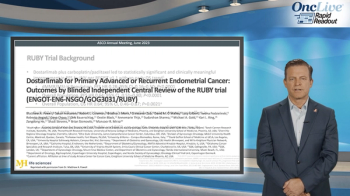
Matthew Powell, MD, presents data from the blinded independent central review of the RUBY trial, which studied dostarlimab in patients with primary advanced or recurrent endometrial cancer.
Experts on ovarian cancer discuss germline and somatic testing practices and provide clinical insights on factors that influence treatment decisions.
A panel of expert gynecologic oncologists introduce themselves and review frontline maintenance treatment options in ovarian cancer.
Experts discuss the possibility to avoid use of chemotherapy by using immunotherapy.
Advertisement
Advertisement
Trending on OncLive
1
Long-Term Cilta-Cel Data Show Low Rates of PFS Events in Standard-Risk R/R Myeloma
2
FDA Updates Axi-Cel Label to Remove Limitation of Use in R/R PCNSL
3
Real-World Data Support Clinical Benefit With Lifileucel in Previously Treated Advanced Melanoma
4
Nonresponse to Bridging Therapy and Peak ALC After Cilta-Cel Are Associated With Neurotoxicity, NRM in Myeloma
5