


Lung Cancer
Latest News
Advertisement
Latest Videos
CME Content































Advertisement
More News
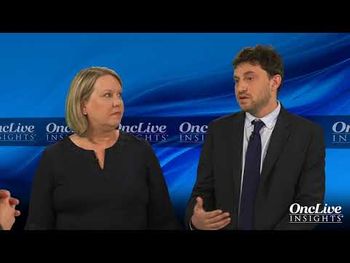
James Urbanic, MD, associate professor, Radiation Medicine and Applied Sciences, University of California, San Diego, discusses the evolution of radiation therapy in the treatment of patients with oligometastatic non–small cell lung cancer.
Sandip P. Patel, MD, medical oncologist, assistant professor of medicine, University of California, San Diego, discusses primary and adaptive resistance to immunotherapy in non–small cell lung cancer (NSCLC).
Suresh S. Ramalingam, MD, sheds light on the recent data with emerging agents in small cell lung cancer.
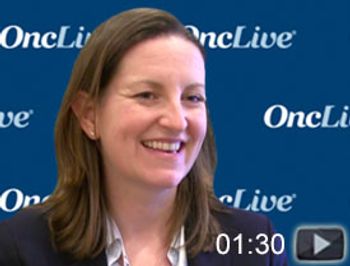
Kathryn A. Gold, MD, associate professor of medicine, University of California, San Diego, discusses the future of osimertinib (Tagrisso) in the treatment of patients with EGFR-mutant lung cancer.
Novel combination regimens anchored by pembrolizumab (Keytruda), atezolizumab (Tecentriq), or nivolumab (Opdivo) are opening the door to new options and an opportunity to personalize therapy in non–small cell lung cancer.

There is very little evidence of clinical validity or clinical utility to justify the widespread use of circulating tumor DNA assays in most patients with advanced cancer, according to a panel of experts from ASCO and the College of American Pathologists

Investigators from Montefiore developed a novel combination that has now demonstrated early-stage efficacy in metastatic lung cancer.
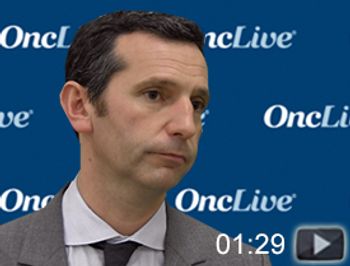
Benjamin Besse, MD, Institut Gustave Roussy, Villejuif, Paris Sud University, discusses the combination of necitumumab (Portrazza) and abemaciclib (Verzenio) in patients with stage IV non–small cell lung cancer.
Next-generation sequencing in metastatic non-small cell lung cancer can save Center for Medicare and Medicaid Services payers $1.4 million to $2.1 million.

Although mutant RAS has proved to be a challenging therapeutic target, recent success with tipifarnib, a biologically active drug known as a farnesyltransferase inhibitor, brings promise for treating solid tumors and hematological malignancies.

Alice T. Shaw, MD, PhD, discusses the challenge of resistance mechanisms in the treatment of patients with non–small cell lung cancer whose tumors harbor ALK rearrangements.

Specific guidance in the HIV-infected population was not previously available, partly because persons living with HIV were previously excluded from cancer clinical trials, creating a knowledge gap.
Matthew D. Hellmann, MD, assistant attending physician, Memorial Sloan Kettering Cancer Center, discusses the process of tumor mutational burden (TMB) testing in patients with lung cancer.
Eilon Kirson, MD, PhD, chief medical officer, Novocure, discusses the LUNAR study in advanced non–small cell lung cancer.
Paul K. Paik, MD, clinical director of the Thoracic Oncology Service, Memorial Sloan Kettering Cancer Center, discusses how the potential approval of lorlatinib may alter the landscape for patients with ALK-positive non–small cell lung cancer (NSCLC).
Lyudmila Bazhenova, MD, professor of clinical medicine, University of California, San Diego, discusses the potential approval of lorlatinib for patients with ALK-positive non–small cell lung cancer (NSCLC).
The FDA has granted a priority review to a supplemental biologics license application for atezolizumab for use in combination with bevacizumab, carboplatin, and paclitaxel for the first-line treatment of patients with metastatic nonsquamous non–small cell lung cancer.
Sai-Hong I. Ou, MD, professor, Division of Hematology/Oncology, Department of Medicine, University of California, Irvine, discusses the use of crizotinib (Xalkori) in the treatment of patients with ROS1-rearranged non–small cell lung cancer (NSCLC).
Sandip P. Patel, MD, medical oncologist, assistant professor of medicine, University of California, San Diego, discusses novel agents for the treatment of patients with non–small cell lung cancer (NSCLC).

A supplemental biologics license application has been submitted to the FDA for the use of pembrolizumab in combination with standard chemotherapy as a treatment for patients with metastatic squamous non–small cell lung cancer.
Alice T. Shaw, MD, PhD, associate professor of medicine, Harvard Medical School, attending physician, Thoracic Cancer Program, Massachusetts General Hospital, discusses lorlatinib in the treatment of patients with lung cancer.
Advertisement
Advertisement
Trending on OncLive
1
Nonresponse to Bridging Therapy and Peak ALC After Cilta-Cel Are Associated With Neurotoxicity, NRM in Myeloma
2
FDA Underscores Risks Associated With DPD Deficiency and Capecitabine/5-FU Use in Cancer Care
3
Long-Term Cilta-Cel Data Show Low Rates of PFS Events in Standard-Risk R/R Myeloma
4
Orca-T With Reduced-Intensity Conditioning Yields Robust Efficacy in Hematologic Malignancies
5