







Lung Cancer
Latest News
Advertisement
Latest Videos

CME Content
































Advertisement
More News

Durvalumab received approval from Health Canada for patients with LS-SCLC whose disease has not progressed after platinum-based chemoradiation.

Educating patients and health care providers about BiTE-associated CRS and ICANS increases comfort levels with giving these agents in outpatient settings.

The bevacizumab biosimilar Jobevne was approved by the FDA for the treatment of several solid tumor types, including mCRC, NSCLC, and RCC.

Osimertinib plus Dato-DXd elicits responses in patients with EGFR-mutated advanced NSCLC who progressed on first-line osimertinib.

Subcutaneous and intravenous pembrolizumab provided comparable efficacy and safety in patients with previously untreated, metastatic non–small cell lung cancer.

Daraxonrasib was safe and active in the pretreated advanced non–small cell lung cancer harboring RAS mutations.

Savolitinib plus osimertinib produced responses in pretreated MET-amplified or -overexpressed advanced non–small cell lung cancer harboring EGFR mutations.
The European Commission has approved subcutaneous amivantamab in multiple indications in advanced EGFR-mutant non–small cell lung cancer.
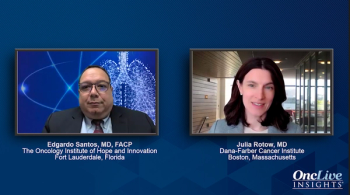
Panelists discuss how emerging therapies like patritumab (a HER3-directed antibody-drug conjugate [ADC]), datopotamab (a TROP2 ADC), and ivonescimab (a PD-1/VEGF bispecific) show distinct toxicity profiles compared with existing treatments, potentially influencing earlier use. Balancing efficacy gains against toxicity risks remains critical in optimizing EGFR-mutated non–small cell lung cancer (NSCLC) treatment.
Panelists discuss how various strategies have been developed to enhance the tolerability of intravenous amivantamab, including premedication, step-up dosing, and infusion rate adjustments. Adoption into clinical practice varies, with many institutions integrating these approaches to mitigate infusion-related reactions and improve patient outcomes.
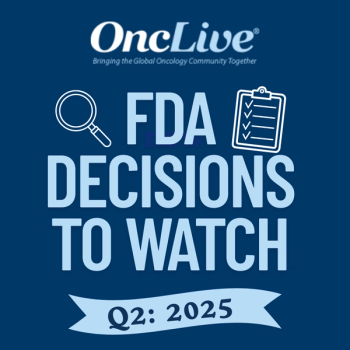
Here is your Q2 2025 preview spotlighting 7 FDA decisions to watch, including upcoming PDUFAs for nivolumab/ipilimumab, belzutifan, UGN-102, avutometinib/defactinib, and more.

Benjamin Herzberg, MD the clinical similarities and key distinctions between sotorasib and adagrasib for KRAS G12C+ NSCLC.

Durvalumab has received perioperative approval in the European Union in patients with resectable non–small cell lung cancer based on data from AEGEAN.
Benjamin Herzberg, MD, discusses current and future research efforts in KRAS-mutated NSCLC.

Updated KEYNOTE-799 data continued to show robust activity with pembrolizumab plus concurrent chemoradiation in unresectable stage III NSCLC.
Longer-term outcomes from LAURA further support the benefit of osimertinib over placebo for patients with unresectable stage III EGFR-mutated NSCLC.

CAN-2049 plus prodrug and continued immune checkpoint inhibition showed a potential OS benefit in advanced non–small cell lung cancer.
The EMA’s CHMP recommended the approval of first-line tislelizumab plus chemotherapy for extensive-stage small cell lung cancer.
Panelists discuss how, if the MARIPOSA trial shows an overall survival advantage exceeding 1 year, the amivantamab-lazertinib combination may see increased frontline use. Subsequent therapy options could include chemotherapy, targeted therapies based on resistance mechanisms, or clinical trials for emerging treatments.
Panelists discuss how medical professionals consider continuing osimertinib with second-line and subsequent therapies based on disease progression, resistance mechanisms, and patient response. It may be combined with other agents or switched depending on clinical trials, biomarkers, and overall treatment goals to optimize outcomes.
The FDA cleared therapeutic options in pNETs/epNETs, MIBC, and mCRPC; experts highlight top abstracts ahead of 2025 EBMT; and more from OncLive.
The EMA’s CHMP has recommended the approval of perioperative nivolumab plus chemotherapy in resectable PD-L1–positive non–small cell lung cancer.

Panelists discuss how treatment decisions for advanced non–small cell lung cancer (NSCLC) without actionable mutations depend on factors like PD-L1 status, histology (eg, squamous [SQ]), and biomarkers like STK11/KEAP1. Chemotherapy may be added based on individual patient factors, with promising advancements expected in 2025.
Panelists discuss how emerging data on novel HER2-targeted agents, including Beamion LUNG-1 (zongertinib) and SOHO-1 (BAY 2927088), show promise for advanced non–small cell lung cancer (NSCLC). Additionally, the eNRGy trial and FDA approval of zenocutuzumab for NRG1 fusion–positive non–small cell lung cancer (NSCLC) offers new treatment avenues. Patient selection will depend on genetic profiling and treatment efficacy.

Fulzerasib plus cetuximab elicited deep efficacy in patients with KRAS G12C–mutated NSCLC enrolled in the phase 2 KROCUS study.
Advertisement
Advertisement
Trending on OncLive
1
Single-Center, Retrospective Data Show Low Rate of Lifileucel Infusion Following Referral in Advanced Melanoma
2
Real-World Data Support Clinical Benefit With Lifileucel in Previously Treated Advanced Melanoma
3
Outcomes With Bridging Therapy Correlate With Cilta-Cel Efficacy, Safety in Multiple Myeloma
4
Long-Term Cilta-Cel Data Show Low Rates of PFS Events in Standard-Risk R/R Myeloma
5