
Tapotoclax showed manageable safety, and it reduced bone marrow blasts and transfusion dependence in MDS after HMAs.

Your AI-Trained Oncology Knowledge Connection!
Tapotoclax showed manageable safety, and it reduced bone marrow blasts and transfusion dependence in MDS after HMAs.

The relapsed/refractory multiple myeloma experts conclude by highlighting current unmet needs in the field and sharing valuable clinical pearls to guide practice and improve patient outcomes.

Guillermo Garcia-Manero, MD, discusses the relationship between hemoglobin levels and QOL in patients with lower-risk myelodysplastic syndromes.
Eric Jonasch, MD, discusses preliminary findings from a trial investigating NKT-2152 in previously treated advanced clear cell renal cell carcinoma.
The key opinion leaders provide essential insights and recommendations for community oncologists to enhance and optimize treatment strategies for their patients with relapsed/refractory multiple myeloma.
The experts in relapsed/refractory multiple myeloma care outline their treatment sequencing strategies for patients who have already received T-cell engaging therapies.
John V. Heymach, MD, PhD, discusses updated outcomes from the AEGEAN trial of perioperative durvalumab vs placebo in resectable non–small cell lung cancer.
Several novel combinations yielded high pCR and mPR rates in patients with resectable non–small cell lung cancer, according to data from the 2024 IASLC conference.

Golcadomide given at 0.4 mg plus R-CHOP elicited a high rate of metabolic responses in patients with previously untreated aggressive B-cell lymphoma.
Liso-cel produced responses across subgroups of relapsed/refractory chronic lymphocytic leukemia or small lymphocytic lymphoma.

Partow Kebriaei, MD, discusses the potential shift away from transplant in acute lymphoblastic leukemia in light of ongoing advancements.

Naval G. Daver, MD, discusses the potential utility of uproleselan in relapsed/refractory acute myeloid leukemia.

Arvind Dasari, MD, MS, discusses considerations and challenges associated with treating patients in the later-line colorectal cancer setting.
Arvind Dasari, MD, MS, discusses fruquintinib as later-line treatment for patients with advanced metastatic colorectal cancer.

Eric Kumar Singhi, MD, discusses unmet needs in the management of small cell lung cancer, highlighting how the ADRIATIC study addressed these needs.
Naval G. Daver, MD, discusses the evolution of survivorship in patients with acute myeloid leukemia.
Naval G. Daver, MD, discusses the potential role of minimal residual disease assessments in acute myeloid leukemia.
Jason A. Mouabbi, MD, discusses shifting standards for HER2 testing for T-DXd administration and areas of ongoing ADC development within breast cancer.
Jason A. Mouabbi, MD, discusses novel endocrine and targeted therapies that may overcome CDK4/6 resistance in HR-positive, HER2-negative breast cancer.
Jason A. Mouabbi, MD, discusses novel endocrine and targeted therapies that may overcome CDK4/6 resistance in HR-positive, HER2-negative breast cancer.

Alessandra Tedeschi, MD, discusses the utility of zanubrutinib plus venetoclax in patients with CLL/SLL harboring deletion 17p and/or TP53 mutations.
John V. Heymach, MD, PhD, and Marina Chiara Garassino, MD, discuss data with perioperative durvalumab in resectable NSCLC in light of the ODAC decision.
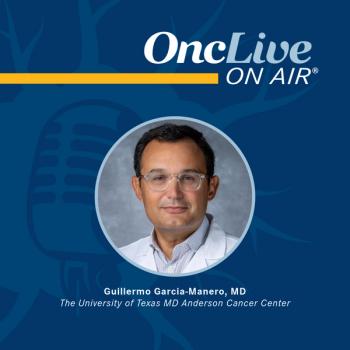
Dr Garcia-Manero discusses findings from research in myelodysplastic syndromes that were presented at the 2024 EHA Congress.

The FDA has approved neoadjuvant durvalumab plus chemotherapy, followed by adjuvant durvalumab, for select resectable non–small cell lung cancer.
Dr Westin discusses the FDA approval of durvalumab plus chemotherapy for patients with dMMR advanced or recurrent endometrial cancer.
Alessandra Tedeschi, MD, discusses 10-year follow-up data on treatment with first-line ibrutinib in treatment-naive chronic lymphocytic leukemia.
Guillermo Garcia-Manero, MD, discusses the investigation of luspatercept dose levels in patients with low-risk myelodysplastic syndrome who require red blood cell transfusions.

Shannon Westin, MD, MPH, FACOG, discusses the FDA approval of durvalumab plus chemotherapy in dMMR advanced or recurrent endometrial cancer.

Time-limited acalabrutinib plus obinutuzumab produced responses in treatment-naive chronic lymphocytic leukemia.

V. Craig Jordan, PhD, of The University of Texas MD Anderson Cancer Center and a pioneer in the field of breast cancer, died on June 9, 2024.