






Breast Cancer
Latest News
Advertisement
Latest Videos





CME Content

































Advertisement
More News
Two breast cancer experts review updates from the SOFT and TAILORx trials and discuss racial disparities in breast cancer treatment and clinical trials.
Charles E. Geyer, MD and Ian E. Krop, MD, PhD provide an overview of the current breast cancer treatment landscape, with a focus on the management of patients with ER+/HER2- metastatic breast cancer.
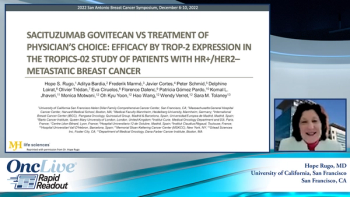
Hope Rugo, MD discusses key data updates on the TROPiCS-02 study on sacituzumab govitecan in patients with endocrine-resistant, HR+/HER2- advanced breast cancer that were recently presented at the 2022 San Antonio Breast Cancer Symposium.

Rupert Bartsch, MD, discusses interim findings produced from the real-world use of neratinib in select patients with hormone receptor-positive, HER2-overexpressed breast cancer.

Joseph A. Sparano, MD, highlights practice-changing clinical trials, novel therapies, the evolving treatment landscape, and unmet needs in the field of breast cancer.

Maryam Lustberg, MD, MPH, discusses the real-world use of ovarian suppression therapy in clinical practice for premenopausal patients with hormone receptor-positive, HER2-positive breast cancer.

Megan Kruse, MD, discusses how socioeconomic disparities and access to health insurance can contribute to poorer overall survival (OS) outcomes in adolescent patients with invasive breast cancer.

Drs Lu, Neven, Jacot, Medford, and Spring highlight updates in the treatment of hormone receptor–positive breast cancer that were presented at the 2022 San Antonio Breast Cancer Symposium.

Jane L. Meisel, MD, discusses the effect of the HER2-low classification for patients with breast cancer.

Dr Oppong discusses findings showing that Black and Hispanic women are more likely than their White counterparts to refuse surgery for nonmetastatic breast cancer, the reasons some patients refuse to undergo surgery, and potential strategies to overcome those objections.

Incidence of surgery refusal has increased by nearly 50% among Black and Hispanic women with potentially curable, nonmetastatic breast cancer over the past decade, according to findings from an analysis of Surveillance, Epidemiology, and End Results Program data.
Dr Rugo discusses overall survival in the TROPiCS-02 trial, post-progression treatments after ribociclib and endocrine therapy in the MONALEESA-2, MONALEESA-3, and MONALEESA-7 studies, and what the AMALEE trial indicates about optimal doses of ribociclib in hormone receptor–positive breast cancer.

Patient history and disease characteristics did not affect outcomes for patients with metastatic HER2-low breast cancer who received fam-trastuzumab deruxtecan-nxki in the DESTINY-Breast04 study.

For the past 3 decades, Carlos L. Arteaga, MD, has focused his research on drug-resistant breast cancers, seeking to identify the causes of resistance and proposing combination therapies to beat that resistance.

Paolo Tarantino, MD, discusses the impact of the phase 3 DESTINY-Breast04 trial in the treatment of HER2-low breast cancer.
Sara A. Hurvitz, MD, reviews updated data comparing trastuzumab deruxtecan versus trastuzumab emtansine for the treatment of HER2+ metastatic breast cancer.

Lubna N. Chaudhary, MD, discusses the correlation between PD-L2 status and progression-free survival rates in treatment-naïve estrogen receptor–positive breast cancer.

Vijayakrishna Gadi, MD, PhD, discusses the investigation of AMUN-003 in triple-negative breast cancer.

Updated results from the phase 3 GIM 2 study confirm previous findings showing that fluorouracil should not be a part of adjuvant chemotherapy for patients with high-risk early breast cancer.
Peter A. Kaufman, MD, reviews data in patients with HER2+ metastatic breast cancer treated with tucatinib-based therapy.

The European Medicines Agency’s Committee for Medicinal Products for Human Use has recommended approval for the use of trastuzumab deruxtecan monotherapy for adults with unresectable or metastatic HER2-low breast cancer.

Nour Abuhadra, MD, discusses what the data from DESTINY-Breast04 means for trastuzumab deruxtecan in the triple-negative breast cancer space and future areas of research for antibody-drug conjugates in this disease.

The FDA has approved updated labeling for capecitabine tablets (Xeloda) under an initiative aimed to ensure labeling information is clinically meaningful and scientifically up to date.

Suchita Pakkala, MD, discusses ongoing efforts to integrate local therapy into HER2-positive breast cancer treatment.

The oral selective estrogen receptor degrader elacestrant has shown promise over standard second-line treatment, such as fulvestrant, for patients with metastatic hormone receptor–positive breast cancer.
Advertisement
Advertisement
Trending on OncLive
1
Single-Center, Retrospective Data Show Low Rate of Lifileucel Infusion Following Referral in Advanced Melanoma
2
Long-Term Cilta-Cel Data Show Low Rates of PFS Events in Standard-Risk R/R Myeloma
3
Real-World Data Support Clinical Benefit With Lifileucel in Previously Treated Advanced Melanoma
4
Dr Riedell on the Long-Term Efficacy of Tisa-Cel in R/R Follicular Lymphoma
5