







Breast Cancer
Latest News
Advertisement
Latest Videos





CME Content































Advertisement
More News

Among patients with ductal carcinoma in situ, a significant portion of recurrences were not genetically related to the primary tumor.

Centering discussion on a patient profile of HER2+ metastatic breast cancer, experts elucidate frontline therapy selection in this setting.

Before moving on to the patient profiles, expert panelists review recent clinical trial data that have impacted treatment selection and sequencing in HER2+ metastatic breast cancer.

Dr Tripathy explains the rationale for the TBCRC049 trial, the challenges of investigating a disease that appears in less than 5% of patients with breast cancer, and potential avenues for future investigations.

Sarah Sammons, MD, discusses findings from the phase 3 EMERALD trial in estrogen receptor–positive, HER2-negative advanced or metastatic breast cancer.

Mridula George, MD, discusses efforts to address unmet needs in HER2-low breast cancer.

Shared insight on the optimal sequencing of therapeutic agents for patients undergoing treatment for HER2+ metastatic breast cancer.
Comprehensive insight on therapeutic classes and agents approved in the setting of HER2+ metastatic breast cancer, with a specific focus on how these therapies fit into current treatment strategies.

This article surveils key advancements in the role of antibody-drug conjugates in solid tumors by examining important clinical trial findings on targeting Trop-2 in breast and lung cancers.

Sara A. Hurvitz, MD, FACP, led a panel of breast cancer experts—Aditya Bardia, MD, MPH; Patrick Neven, MD, PhD; and Kevin Kalinsky, MD, MS—in a review of key data from the 2021 San Antonio Breast Cancer Symposium in ER-positive breast cancer.

Sara M. Tolaney, MD, MPH, reviews practice-changing data sets throughout breast cancer and provides perspective on potential treatment approaches in the absence of definitive results.

Komal Jhaveri, MD, FACP, discusses the implications of the phase 2 TUXEDO-1 trial in patients with HER2-positive metastatic breast cancer with brain metastases.

Tiffany A. Traina, MD, discusses the implications of the phase 3 EMERALD trial in advanced estrogen receptor–positive, HER2-negative breast cancer.
Komal Jhaveri, MD, FACP, discusses the implications of data from the phase 3 DESTINY-Breast03 trial in patients with HER2-positive metastatic breast cancer.

Harold J. Burstein, MD, PhD, discusses treatment updates across HER2-positive breast cancer, adjuvant advances in estrogen receptor–positive disease, and the domino effect of immunotherapy in triple-negative breast cancer.

At a median follow-up of 3.5 years, adjuvant olaparib significantly improved overall survival vs placebo in patients with germline BRCA-mutated, HER2-negative, high-risk early breast cancer who received prior chemotherapy before or after surgery.

Leading oncologists in breast cancer share their perspectives on the biggest abstracts that were presented throughout 2021 .

Mutations on the ESR1 gene, which encodes the estrogen receptor, have emerged as an important driver of resistance to endocrine therapies, which form the backbone of treatment for patients with ER-positive, HER2-negative breast cancer.

Amcenestrant did not improve progression-free survival per independent central review vs physician’s choice of endocrine treatment in select patients with locally advanced or metastatic, estrogen receptor–positive, HER2-negative breast cancer, missing the primary end point of the phase 2 AMEERA-3 trial.

Aditya Bardia, MD, MPH, discusses the use of endocrine therapy in estrogen receptor–positive breast cancer.

Nancy E. Davidson, MD, discusses the future of HER2-targeted therapies in breast cancer.

The historical boundaries of what was possible in the management of patients with breast cancer continue to be challenged, evidenced by the use of HER2-directed therapies in patients with brain metastases, de-escalated approaches in patients with visceral disease, and less-invasive surgical techniques for patients with lymph node involvement.

The FDA has approved olaparib for the adjuvant treatment of patients with germline BRCA-mutated, HER2-negative, high-risk early breast cancer who have previously received chemotherapy either before or after surgery.

Tiffany Traina, MD, discusses the body of evidence supporting the use of CDK4/6 inhibitors in hormone receptor–positive, HER2-negative breast cancer, shifting standards of care in HER2-positive disease, as well as biomarkers of response with checkpoint inhibitors and PARP inhibitors in triple-negative breast cancer.
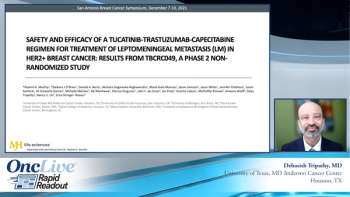
Dr. Tripathy reviews the safety and efficacy data from a phase 2 non-randomized study of tucatinib-trastuzumab-capecitabine regimen in patients with leptomeningeal metastasis.
Advertisement
Advertisement
Trending on OncLive
1
Single-Center, Retrospective Data Show Low Rate of Lifileucel Infusion Following Referral in Advanced Melanoma
2
Long-Term Cilta-Cel Data Show Low Rates of PFS Events in Standard-Risk R/R Myeloma
3
Real-World Data Support Clinical Benefit With Lifileucel in Previously Treated Advanced Melanoma
4
Dr Riedell on the Long-Term Efficacy of Tisa-Cel in R/R Follicular Lymphoma
5