







Breast Cancer
Latest News
Advertisement
Latest Videos





CME Content

































Advertisement
More News

The FDA has granted a fast track designation to CX-5461 (Pidnarulex) as a potential therapeutic option for patients with breast and ovarian cancers that harbor BRCA1/2, PALB2, or other homologous recombination deficiency mutations.

Barry Rosen, MD, provides an overview of circulating tumor DNA’s role in early stage breast cancer detection and management.

Expert oncologist Aditya Bardia, MD, MPH, provides a broad overview of minimal residual disease testing across a number of tumor types and clinical settings.

After discussing a few more key datasets from the SABCS 2021 Virtual Meeting, expert panelists discuss how they would approach treatment in several subsets of breast cancer.
Focusing on datasets from the SABCS 2021 Virtual Meeting, panelists consider novel approaches to the management of brain metastases in breast cancer.
Expert panelists share their perspectives on metastatic breast cancer management datasets from the SABCS 2021 Virtual Meeting.
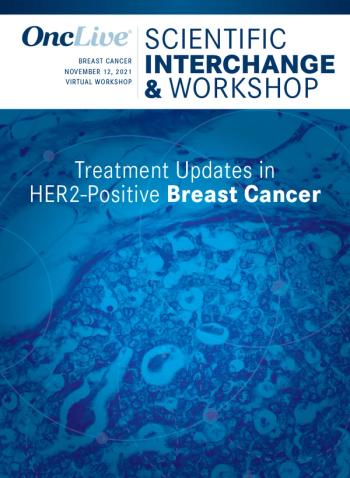
This article provides a summary of data on treatment approaches for HER2-positive breast cancer presented at conferences in 2021 and offers a review of how findings may affect clinical approaches to escalating or de-escalating therapy in patients with early-stage disease, optimally sequencing HER2-targeted therapy in patients with metastatic breast cancer, and selecting HER2-targeted agents based on the burden of CNS disease.

The FDA has granted a fast track designation to gedatolisib for use as a potential therapeutic option in patients with hormone receptor–positive, HER2-negative metastatic breast cancer who experienced disease progression on CDK4/6 therapy.

Advances in the treatment of solid tumors and hematologic malignancies have resulted in the development of thera-peutic regimens that can be administered at various points in a patient’s care.
Dr Gary Ulaner and Dr Jeremy Force answer questions submitted by attendees of the live webinar discussing the role of various strategies to detect estrogen receptor (ER)-positive breast cancer, with particular focus on the role of 18-F FES-PET imaging in diagnosis and treatment of ER-positive breast cancer.

Dr Jeremy Force illustrates how FES-PET aids in the treatment of patients with breast cancer through a clinical case.
Dr Jeremy Force illustrates how FES-PET aids in the treatment of patients with breast cancer through a clinical case.

Hope S. Rugo, MD, FASCO, Rita Nanda, MD, William J. Gradishar, MD, and Tiffany A. Traina, MD discuss the selective immunomodulating microtubule-binding agent plinabulin, plus several other novel chemoprotective therapies under exploration, including trilaciclib.

Haythem Y. Ali, MD, member, Henry Ford Cancer Institute, Henry Ford Health System, discusses the need to understand real-world disparities with BRCA testing referrals and uptake in patients with triple-negative breast cancer.
Dr Jeremy Force illustrates how FES-PET aids in the care of patients with breast cancer through a clinical case.
A comprehensive analysis of the potential role of FES-PET imaging in assessing ER status in tumors that are difficult to biopsy and in evaluating the extent of disease.

Carey K. Anders, MD, discusses lessons learned from the phase 3 OlympiA trial in BRCA-mutated breast cancer.

The FDA has granted a fast track designation to enobosarm as a potential therapeutic option for patients with androgen receptor–positive, estrogen receptor–positive, HER2-negative, metastatic breast cancer who progressed on a nonsteroidal aromatase inhibitor, fulvestrant, and a CDK4/6 inhibitor, and who have AR staining of 40% or more in cancer tissue.

Susan Faye Dent, MD, discusses the clinical implications of the phase 3 MONALEESA-2 trial in hormone receptor–positive, HER2-negative breast cancer.
Dr Dietz discusses her experience as a woman in surgical oncology, the importance of bridging gender disparities, and her advice to women entering the health care industry.

Melissa Geller, MD, MS, and colleagues discuss key clinical trials that have changed the landscapes of HER2-positive breast cancer and triple-negative breast cancer, the role of first- and second-line maintenance therapy in ovarian cancer, and key updates in cervical and endometrial cancers.

Molecular testing is an established and essential precursor to treatment for patients with non–small cell lung cancer based on the volume of actionable targets, such as EGFR and KRAS G12C mutations, as well as PD-L1 status.

Adam M. Brufsky, MD, PhD, FACP, discusses efficacy data with enobosarm in metastatic estrogen receptor–positive, androgen receptor–positive, HER2-negative breast cancer.

Sara M. Tolaney, MD, MPH, chief, discusses the importance of evaluating enobosarm in metastatic estrogen receptor–positive, HER2-negative breast cancer.
Expert perspective on the applications of FES-PET imaging in treatment decision-making in patients with breast cancer.
Advertisement
Advertisement
Trending on OncLive
1
Single-Center, Retrospective Data Show Low Rate of Lifileucel Infusion Following Referral in Advanced Melanoma
2
Real-World Data Support Clinical Benefit With Lifileucel in Previously Treated Advanced Melanoma
3
Outcomes With Bridging Therapy Correlate With Cilta-Cel Efficacy, Safety in Multiple Myeloma
4
Long-Term Cilta-Cel Data Show Low Rates of PFS Events in Standard-Risk R/R Myeloma
5