






Breast Cancer
Latest News

November 16th 2021
By Kyle Doherty
The Cancer Cell Map Initiative, developed by investigators at the University of California San Francisco and the University of California San Diego, has successfully charted how hundreds of genetic mutations involved in breast cancer and cancers of the head and neck affect the activity of proteins that ultimately lead to disease.
Advertisement
Latest Videos








CME Content































Advertisement
More News

Gretchen G. Kimmick, MD, MS, discusses the results of the phase 2 ATEMPT trial in early-stage HER2-positive breast cancer

Breast oncologists explain results from the phase III MONALEESA-2 trial presented at ESMO 2021, and its clinical implications.
Leronlimab was found to improve survival in patients with CCR5-positive metastatic triple-negative breast cancer in whom at least 2 prior lines of therapy had failed, according to data from an updated analysis of a Compassionate Use Study, a phase 1b/2 study, and from a basket study.

ESMO Clinical Practice Guidelines indicate that the management of metastatic breast cancer requires nuanced and multidisciplinary decision making to optimize and personalize locoregional, systemic, and supportive care.

Paul Lawrence Baron, MD, discussed best practices for determining a patient’s risk of developing breast cancer, the significance of targeting HER2 in patients with early-stage and metastatic disease, and remaining questions with radiation therapy in the field.

Paul Lawrence Baron, MD, discusses contributing factors for developing breast cancer.
Standard chemotherapy has historically been the mainstay of treatment for patients with diagnoses of early-stage TNBC, but there remains an unmet need to identify novel therapies that improve outcomes and, equally important, to discern which patients may benefit from a given treatment.
Key opinion leaders review data from the phase III TULIP trial in patients with pre-treated HER2-positive locally advanced or metastatic breast cancer and the ExteNET study on extended adjuvant treatment with neratinib.

Experts highlight key messages regarding optimal identification and management of interstitial lung disease.
Sara Hurvitz, MD, discusses the coopERA study and how these data, along with findings from other clinical trials, could lead to significant changes in treatment for patients with ER-positive/HER2-negative breast cancer.
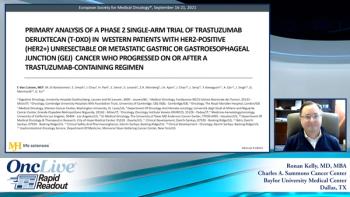
Ronan Kelly, MD, MBA, discusses data from the presentation “Primary analysis of a phase II single-arm trial of trastuzumab deruxtecan (T-DXd) in western patients (Pts) with HER2-positive (HER2+) unresectable or metastatic gastric or gastroesophageal junction (GEJ) cancer who progressed on or after a trastuzumab-containing regimen.” (Van Cutsem et al, ESMO 2021, LBA55)

Drs. Sara Tolaney and Mark Pegram discuss promising therapies and upcoming mechanisms of actions to treat HER2+ metastatic breast cancer.
Breast cancer experts, Drs. Sara Tolaney and Mark Pegram discuss ongoing and noteworthy trials with trastuzumab deruxtecan in mBC.
Sara Tolaney, MD, and Mark Pegram, MD, discuss their rationale for sequencing of most effective therapy in treatment of patients with metastatic breast cancer.
Expert oncologists discuss data from several phase 2 and phase 3 trials presented at ESMO 2021 on the use of trastuzumab deruxtecan for HER2-positive breast cancer and how it impacts their practices.

The European Commission has approved pembrolizumab plus chemotherapy for the frontline treatment of patients with locally recurrent unresectable or metastatic triple-negative breast cancer whose tumors have a PD-L1 expression combined positive score of 10 or higher and who have not previously received chemotherapy for metastatic disease.

Shared insight on the benefit of multidisciplinary care and the pulmonologist’s role in identifying and managing interstitial lung disease.
Key opinion leaders share risk-benefit considerations when utilizing therapies that may increase a patient’s risk of developing ILD.
Breast cancer experts, Sara Tolaney, MD, and Mark Pegram, MD, discuss current standard of care in sequencing of therapies in mBC and the effect of DESTINY-Breast03 data on sequencing going forward.
Mark Pegram, MD, and Sara Tolaney, MD, review the DESTINY-Breast03 study design, clinical efficacy, and safety data.
Sara Tolaney, MD, describes trastuzumab deruxtecan and the data that led to its accelerated approval in HER2+ breast cancer.
Mark Pegram, MD, provides a historical perspective on recent advancements made in the treatment landscape for patients with HER2-positive breast cancer.

Elacestrant monotherapy improved progression-free survival over standard-of-care (SOC) treatment in patients with estrogen receptor–positive, HER2-negative breast cancer, including those whose tumors harbored ESR1 mutations, meeting the primary end points of the phase 3 EMERALD trial.

Hope S. Rugo, MD, FASCO, provides her insights on the final analysis data from the international phase 3 ASCENT trial.
Francisco Javier Esteva, MD, PhD, discussed the current approach to treating patients with early-stage HER2-positive breast cancer, unmet needs in the space, and future directions with neratinib and T-DM1.
Advertisement
Advertisement
Trending on OncLive
1
Long-Term Cilta-Cel Data Show Low Rates of PFS Events in Standard-Risk R/R Myeloma
2
FDA Updates Axi-Cel Label to Remove Limitation of Use in R/R PCNSL
3
Real-World Data Support Clinical Benefit With Lifileucel in Previously Treated Advanced Melanoma
4
Nonresponse to Bridging Therapy and Peak ALC After Cilta-Cel Are Associated With Neurotoxicity, NRM in Myeloma
5