







Breast Cancer
Latest News
Advertisement
Latest Videos







CME Content































Advertisement
More News

Baseline tumor immunogenicity may be associated with higher pathologic complete response rates and favorable outcomes in hormone receptor-positive, HER2-positive early stage breast cancer when comparing de-escalated neoadjuvant ado-trastuzumab emtansine with or without endocrine therapy, vs trastuzumab plus endocrine therapy.

Hope S. Rugo, MD, discusses the overall survival data with first-line pembrolizumab plus chemotherapy as a treatment for patients with metastatic triple-negative breast cancer, as reported in the phase 3 KEYNOTE-355 trial.

The combination of ribociclib and letrozole demonstrated a statistically significant and clinically meaningful overall survival benefit compared with letrozole alone in the first-line setting for postmenopausal patients with hormone receptor–positive, HER2-negative advanced breast cancer, according to results from the phase 3 MONALEESA-2 trial.

Fam-trastuzumab deruxtecan-nxki demonstrated a clinically meaningful and statistically significant improvement in progression-free survival vs standard of care trastuzumab emtansine for patients with previously treated HER2-positive metastatic breast cancer.

The addition of carboplatin to neoadjuvant paclitaxel followed by doxorubicin and cyclophosphamide significantly improved pathological complete response rates and event-free survival in patients with treatment-naïve triple-negative breast cancer.

The European Medicines Agency’s Committee for Medicinal Products for Human Use has adopted a positive opinion of pembrolizumab plus chemotherapy in the treatment of patients with locally recurrent unresectable or metastatic triple-negative breast cancer whose tumors have a PD-L1 combined positive score of 10 or higher and who have not previously received chemotherapy for metastatic disease.

The 2021 ESMO Congress, held as a virtual format for the second consecutive year, is fast approaching and isn’t holding back in terms of pivotal data across malignancies, especially in breast cancer and gynecologic cancers.

Shared insight on the optimal management of patients who develop interstitial lung disease while receiving therapy for breast cancer.

In light of breast cancer therapies with the potential to cause interstitial lung disease, experts consider important patient risk factors and best monitoring practices.

Ricardo Costa, MD, MSc, discusses the patient population included in the phase 3 OlympiA trial in breast cancer.

Dr Pegram and colleagues focus on key clinical trials such as DESTINY-Breast01, HER2CLIMB, NALA, and SOPHIA in the setting of advanced HER2-positive breast cancer and discuss the practical considerations of these data.
In the second segment, Dr Pegram and colleagues discuss the clinical implications of the data from select trials in the neoadjuvant and adjuvant settings for patients with HER2-positive breast cancer.
In the first segment, Dr Pegram and colleagues highlight some of the challenges and remaining unmet needs in the management of patients with HER2-positive breast cancer.
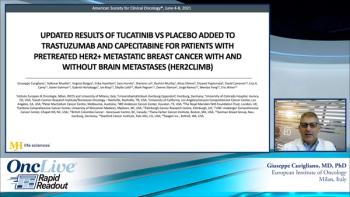
Expert oncologist Giuseppe Curigliano, MD, PhD, reflects on the updated results of the HER2CLIMB study evaluating tucatinib against placebo, each in combination with trastuzumab and capecitabine, in patients with pretreated HER2+ metastatic breast cancer.

An overview of optimal multidisciplinary care for a patient who presents with HER2+ metastatic breast cancer.
Key opinion leaders highlight the challenges inherent in using multidisciplinary care to manage breast cancer, particularly when a patient is seen at multiple institutions.

Following the integration of immunotherapy into the treatment paradigm of triple-negative breast cancer, a multidisciplinary panel of experts, brought together by the Society for Immunotherapy of Cancer, published the first clinical practice guidelines focused on navigating clinical decisions with immunotherapy in breast cancer.

Sara A. Hurvitz, MD, discusses outcomes with sacituzumab govitecan-hziy in patients with metastatic triple-negative breast cancer.
Focusing on the value of electronic systems and tumor boards, experts detail how best to communicate across disciplines in the management of breast cancer.
Shared insight on how nuanced multidisciplinary care can positively impact outcomes when treating a patient with breast cancer.
Jennifer K. Litton, MD, discusses the rationale for examining neoadjuvant talazoparib in patients with BRCA1/2-positive, early HER2-negative breast cancer, safety and efficacy results from NEOTALA, and next steps for research.

Roche has made the voluntary decision to withdraw the indication for the use of atezolizumab plus chemotherapy in the treatment of adult patients with unresectable locally advanced or metastatic triple-negative breast cancer whose tumors express PD-L1.

Acquired resistance to endocrine therapy has presented challenges for patients with hormone receptor–positive breast cancer.

Induction with lenrolimab resulted in an improvement in modified progression-free survival and modified overall survival in patients with metastatic triple-negative breast cancer.
Comprehensive details on how multidisciplinary care is applied during a patient’s treatment journey, with a focus on pulmonology and critical care.
Advertisement
Advertisement
Trending on OncLive
1
Long-Term Cilta-Cel Data Show Low Rates of PFS Events in Standard-Risk R/R Myeloma
2
FDA Updates Axi-Cel Label to Remove Limitation of Use in R/R PCNSL
3
Nonresponse to Bridging Therapy and Peak ALC After Cilta-Cel Are Associated With Neurotoxicity, NRM in Myeloma
4
Real-World Data Support Clinical Benefit With Lifileucel in Previously Treated Advanced Melanoma
5