





Gastrointestinal Cancer
Latest News
Advertisement
Latest Videos

CME Content

































Advertisement
More News
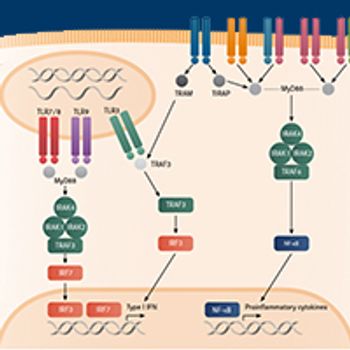
Toll-like receptors, a group of proteins that are components of innate immunity, are emerging as promising targets in a new wave of immunotherapies under development.
There has been a significant evolution in the care of patients with metastatic colorectal cancer over the past 20 years. However, this is only the tip of the iceberg and we are going to see more and more subgroups being defined and refined with many more rationally targeted agents matching these alterations.
Scott Kopetz, MD, PhD, FACP, associate professor, Department of Gastrointestinal Medical Oncology, Division of Cancer Medicine, The University of Texas MD Anderson Cancer Center, discusses the significance of tumor sidedness in colorectal cancer.



The FDA has approved ramucirumab (Cyramza) monotherapy for patients with hepatocellular carcinoma who have an alpha fetoprotein of ≥400 ng/ML and have been previously treated with sorafenib.
The optimal integration of new drugs into the treatment paradigm of HCC requires several key developments, including greater research into biomarkers that would help inform therapy choices, earlier treatment for patients diagnosed with HCC, and clinical trials that test combination strategies.

Anthony Shields, MD, PhD, professor, Department of Oncology, Molecular Imaging and Diagnostics Program, Karmanos Cancer Institute, discusses the prevalence of genetic testing colorectal cancer.
Philip A. Philip, MD, PhD, FRCP, professor, Department of Oncology, Karmanos Cancer Institute, discusses the use of FOLFIRINOX in patients with locally advanced pancreatic cancer.
A vaccine targeting GUCY2C, a commonly overexpressed protein in patients with early-stage colorectal cancer, induced antibody and T-cell responses toward the specified target and demonstrated an acceptable safety profile in this patient population
Scott Kopetz, MD, PhD, FACP, explains the biologic difference between left- and right-sided colorectal cancer and highlights recent research on tumor sidedness and its impact on clinical practice.

During a recent panel discussion, neuroendocrine tumor experts Simron Singh, MD, MPH, and Jonathan R. Strosberg, MD, provided insight on which patients are the best candidates for these approved treatments and how to sequence therapy to optimize outcomes.
Lowell B. Anthony, MD, FACP, chief, Division of Medical Oncology, University of Kentucky Markey Cancer Center, discusses sequencing strategies for patients with gastroenteropancreatic neuroendocrine tumors.

Amit Mahipal, MBBS, senior associate consultant, Division of Medical Oncology, Department of Oncology, associate professor of oncology, Mayo Clinic, discusses emerging molecular markers in patients with metastatic colorectal cancer (mCRC).
Lowell B. Anthony, MD, FACP, sheds light on important data that have shaped the current neuroendocrine tumors treatment paradigm and highlights notable ongoing studies.
Richard Kim, MD, assistant professor of oncology at University of South Florida College of Medicine, medical oncologist in the Department of Gastrointestinal Oncology at Moffitt Cancer Center, discusses the potential of ramucirumab in the treatment of advanced hepatocellular carcinoma.

Michael J. Overman, MD, professor in the Department of Gastrointestinal Medical Oncology, Division of Cancer Medicine, The University of Texas MD Anderson Cancer Center, discusses tailoring approaches to molecular subsets of patients with metastatic colorectal cancer.

The combination of pembrolizumab (Keytruda) and chemotherapy did not improve overall survival or progression-free survival compared with standard chemotherapy alone for the frontline treatment of patients with advanced gastric or gastroesophageal junction adenocarcinoma.

Mark H. O’Hara, MD, assistant professor of medicine, Hospital of the University of Pennsylvania, discusses the rationale for evaluating APX005M in combination with chemotherapy and nivolumab (Opdivo) in pancreatic cancer.
Kim A. Reiss Binder, MD, assistant professor of medicine in the Division of Hematology Oncology at the University of Pennsylvania, discusses data on maintenance therapy with rucaparib (Rubraca) in patients with pancreatic cancer.
Jonathan Mizrahi, MD, a hematology/oncology fellow at The University of Texas MD Anderson Cancer Center, discusses the importance of personalized care in patients with metastatic colorectal cancer.
Geoffrey Y. Ku, MD, medical oncologist, Memorial Sloan Kettering Cancer Center, discusses the role of durvalumab in the treatment of patients with gastric cancer.
Advertisement
Advertisement
Trending on OncLive
1
Single-Center, Retrospective Data Show Low Rate of Lifileucel Infusion Following Referral in Advanced Melanoma
2
Long-Term Cilta-Cel Data Show Low Rates of PFS Events in Standard-Risk R/R Myeloma
3
Real-World Data Support Clinical Benefit With Lifileucel in Previously Treated Advanced Melanoma
4
Dr Riedell on the Long-Term Efficacy of Tisa-Cel in R/R Follicular Lymphoma
5