




Hematologic Oncology
Latest News

Enrollment to Discontinue for SELECT-AML-1 Trial of Tamibarotene Triplet in Newly Diagnosed RARA+ AML
By Chris Ryan
Advertisement
Latest Videos




CME Content

































Advertisement
More News

Focusing on the current treatment landscape for patients with AYA ALL, the panel discusses clinical practices and treatment decisions based on age.

Francisco Hernandez-Ilizaliturri, MD, discusses deciding between CAR T-cell therapies or approved bispecific antibodies for diffuse large B-cell lymphoma.

Subcutaneous epcoritamab demonstrated safety when given in the outpatient setting in relapsed/refractory diffuse large B-cell and follicular lymphoma.

The FDA is requiring an additional trial demonstrating an OS benefit with Iomab-B to support the planned filing of the biologics license application for the agent.

Alemtuzumab was FDA granted orphan drug designation as part of lymphodepletion prior to UCART22 in relapsed/refractory B-cell acute lymphoblastic leukemia.

Talha Munir, MBChB, PhD, discusses an adverse effect–based economic analysis of zanubrutinib vs acalabrutinib in patients with B-cell malignancies.

Anita Rijneveld, MD, discusses outcomes with the addition of blinatumomab to prephase and consolidation therapy for patients with adult B-cell acute lymphoblastic leukemia.

Antonio Martin Jimenez Jimenez, MD, discusses the clinical implications of PBSC from HLA-MMUD and PTCy for GVHD prophylaxis in hematological malignancies.

Uwe Platzbecker, MD, discusses efficacy data with the combination of all-trans retinoic acid and arsenic trioxide in high-risk acute promyelocytic leukemia.
Experts on acute lymphoblastic leukemia share their clinical experiences, describe high-risk features, and provide insights on risk stratification practices.
A panel of experts from Atrium Health Levine Cancer Institute present a patient case and provide an overview of adolescent and young adult (AYA) acute lymphoblastic leukemia (ALL).

The FDA has granted priority review to asciminib for newly diagnosed Philadelphia chromosome–positive chronic myeloid leukemia in chronic phase.
Dan Pollyea, MD, MS, discusses the mechanism of action for the menin inhibitor revumenib in KMT2A-rearranged relapsed/refractory acute myeloid leukemia.

The FDA has extended the PDUFA date for the NDA seeking the approval of revumenib for patients with relapsed/refractory KMT2A-rearranged acute leukemia.

Blinatumomab added to consolidation chemotherapy led to a significant OS benefit in MRD-negative B-cell precursor acute lymphoblastic leukemia.
Justin M. Watts, MD, discusses the design and purpose of a phase 1 trial evaluating INCB057643 in myelofibrosis and other advanced myeloid neoplasms.

Iopofosine I 131 generated a major response rate of 56.4% in patients with relapsed/refractory Waldenström macroglobulinemia.

The FDA has accepted the resubmission of a BLA for remestemcel-L in pediatric steroid-refractory acute graft-vs-host-disease.
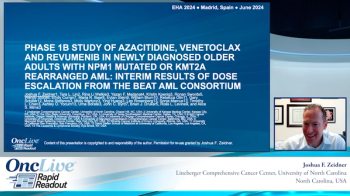
A Phase 1b study (NCT03013998) to determine the safety and recommended dose of Revumenib combined with Aza/Ven in patients with newly diagnosed AML ≥ 60 years old with NPM1mut or KMT2Ar and who are not candidates or do not wish to pursue intensive induction therapy.

Justin M. Watts, MD, discusses 5-year efficacy and safety data for olutasidenib in IDH1-mutant, relapsed/refractory AML.
Mazyar Shadman, MD, MPH, discusses the rationale for combining sonrotoclax plus zanubrutinib for treatment-naive chronic lymphocytic leukemia.

Craig Eckfeldt, MD, PhD, discusses how improved minimal residual disease testing methods have impacted the acute myeloid leukemia treatment paradigm.

Mark Juckett, MD, discusses ways the treatment paradigm has changed for patients with relapsed/refractory acute myeloid leukemia.
Timothy Hughes, MD, MBBS, FRACP, FRCPA, on safety data for asciminib in Philadelphia chromosome–positive chronic-phase chronic myeloid leukemia.
Dr. Hannah Choe discusses a clinical scenario of a patient with GVHD who has progressed after multiple lines of treatment. She explores how the availability of CSF-1R inhibitors could fit into the evolving treatment landscape for managing this difficult-to-treat patient population. Dr. Choe provides her perspectives on the potential role and clinical implications of targeting this pathway as an emerging therapeutic approach for GVHD.
Advertisement
Advertisement
Trending on OncLive
1
Single-Center, Retrospective Data Show Low Rate of Lifileucel Infusion Following Referral in Advanced Melanoma
2
Real-World Data Support Clinical Benefit With Lifileucel in Previously Treated Advanced Melanoma
3
Outcomes With Bridging Therapy Correlate With Cilta-Cel Efficacy, Safety in Multiple Myeloma
4
Long-Term Cilta-Cel Data Show Low Rates of PFS Events in Standard-Risk R/R Myeloma
5