


Melanoma & Skin Cancer
Latest News

Advertisement
Latest Videos
CME Content
































Advertisement
More News

The FDA has granted a fast track designation to the novel immunostimulant 7HP349 for use in combination with a CTLA-4 inhibitor in patients with unresectable or metastatic malignant melanoma in whom a PD-L1 inhibitor has failed.

The fixed-dose combination of relatlimab and nivolumab continued to demonstrate a consistent progression-free survival benefit, showcased a clinically meaningful improvement in overall survival, and elicited a higher objective response rate than nivolumab alone in previously untreated patients with metastatic or unresectable melanoma.
The addition of bempegaldesleukin to nivolumab did not significantly improve progression-free survival, objective response rate, or overall survival vs nivolumab alone in the frontline treatment of patients with unresectable or metastatic melanoma, missing the primary end points of the phase 3 PIVOT IO-001 trial.
The FDA has placed a partial clinical hold on the phase 1 NEON-2 trial examining the combination of davoceticept and pembrolizumab in patients with advanced solid tumors or lymphoma.
Pembrolizumab significantly improved distant metastasis–free survival vs placebo when used as an adjuvant treatment in patients with resected stage IIB and IIC melanoma, according to additional data from the phase 3 KEYNOTE-716 trial.
Zeynep Eroglu, MD, discusses the utilization of circulating tumor DNA in patients with melanoma.

“I don’t intend to rest on any laurels as thereis still much more to be done.”
Dr Milhem discusses the unique mechanism of action and delivery method of RP1, which is being evaluated in the IGNYTE trial for patients with solid tumors, as well as the parallel studies ARTACUS and CERPASS, which are further exploring the agent.
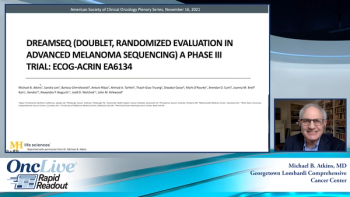
Michael Atkins, MD, shares data presented at the 2021 American Society of Clinical Oncology Plenary Series regarding results from the phase 3 ECOG-ACRIN EA6134 trial, DREAMseq, evaluating the use of up-front dual immunotherapy in patients with BRAF V600–mutant advanced melanoma.
Frontline administration of the checkpoint inhibitors ipilimumab plus nivolumab followed by the targeted agents dabrafenib plus trametinib improved overall survival in patients with BRAF V600–mutant melanoma vs the reverse sequence of combinations, according to data from the phase 3 DREAMseq trial presented during the ASCO Virtual Plenary Series.
The FDA has approved tebentafusp-tebn for the treatment of HLA-A*02:01–positive adult patients with unresectable or metastatic uveal melanoma.
The PD-L1 antibody cosibelimab, when given at a fixed dose of 800 mg every 2 weeks, elicited a promising objective response rate with acceptable safety and tolerability in patients with metastatic cutaneous squamous cell carcinoma, meeting the primary end point of a phase 1 registration-enabling trial.
Jeffrey S. Weber, MD, PhD, overviews the successes made in the melanoma setting in the past decade and the challenges to overcome in the future.
Omid Hamid, MD, discusses the differences in evaluation criteria for tumor-infiltrating lymphocytes therapy in melanoma.
Omid Hamid, MD, discusses the efficacy of tumor-infiltrating lymphocyte therapy following immunotherapy in advanced melanoma.
The diffusing alpha-emitter radiation therapy, Alpha DaRT, was found to elicit complete responses per RECIST v1.1 criteria in 10 patients with malignant skin and soft tissue cancers who are enrolled to an ongoing single-institution pilot feasibility trial.
The FDA has accepted an investigational new drug application for the photoimmunotherapy treatment, RM-1995, for patients with advanced cutaneous squamous cell carcinoma or head and neck squamous cell carcinoma.
Our discussion closes with the presentation of phase 2 clinical trial data of neoadjuvant cemiplimab in locally regionally advanced cutaneous squamous cell carcinoma.
Our final clinical case scenario is presented, and Kevin Emerick, MD, uses his experience to determine a proper course of action.
Drs In, Cohen, and Bakst discuss the use of other therapies for cutaneous squamous cell carcinoma, as well as what they believe is the future of systemic therapy for this disease.
Dr In comments on data from the KEYNOTE-629 trial that focused on the use of pembrolizumab as a therapy option for patients with cutaneous squamous cell carcinoma.
Drs Bakst and Cohen close out our second clinical case scenario by providing their thoughts on potential radiation therapy and using cemiplimab.
Jeffrey S. Weber, MD, PhD, discusses unmet needs in ocular and mucosal melanoma.
Drs In and Emerick analyze the data from our second clinical case scenario and tell us what they would do if it were their patient.
Dr Bakst comments on radiation treatment therapies and the standard of care for cutaneous squamous cell carcinoma.
Advertisement
Advertisement
Trending on OncLive
1
Single-Center, Retrospective Data Show Low Rate of Lifileucel Infusion Following Referral in Advanced Melanoma
2
Outcomes With Bridging Therapy Correlate With Cilta-Cel Efficacy, Safety in Multiple Myeloma
3
Real-World Data Support Clinical Benefit With Lifileucel in Previously Treated Advanced Melanoma
4
Long-Term Cilta-Cel Data Show Low Rates of PFS Events in Standard-Risk R/R Myeloma
5