
Armin Ghobadi, MD, discusses the evolution and expansion of CAR T-cell therapy in oncology and how to maximize its application across liquid and solid tumors.

Your AI-Trained Oncology Knowledge Connection!
Armin Ghobadi, MD, discusses the evolution and expansion of CAR T-cell therapy in oncology and how to maximize its application across liquid and solid tumors.
Nancy L. Bartlett, MD, discusses factors in treatment decisions for patients with advanced-stage Hodgkin lymphoma.
Nancy Bartlett, MD, Koman Chair in Medical Oncology, Washington University School of Medicine, Siteman Cancer Center, discusses treatment regimens for patients with Hodgkin lymphoma.
Heinz-Josef Lenz, MD, associate director for Adult Oncology and co-leader of the Gastrointestinal Cancers Program, USC Norris Comprehensive Cancer Center, discusses the benefit of regorafenib (Stivarga) in the treatment of patients with colorectal cancer (CRC).
Brad Kahl, MD, professor in the Department of Medicine, Washington University School of Medicine in St. Louis, Siteman Cancer Center, discusses the impact of venetoclax (Venclexta) in the treatment of patients with chronic lymphocytic leukemia (CLL).
Toni Choueiri, MD, director, Lank Center for Genitourinary Oncology, director, Kidney Cancer Center, Jerome and Nancy Kohlberg Associate Professor of Medicine, Harvard Medical School, Dana-Farber Cancer Institute, discusses the impact of the JAVELIN Renal 100 trial on the treatment landscape of renal cell carcinoma.
Hisham Mehanna, PhD, BMedSc, MBChB, FRCS, chair, Head and Neck Surgery director, Institute of Head and Neck Studies and Education at the School of Cancer Studies, University of Birmingham, discusses the new staging system for patients with HPV-positive head and neck cancer.
Edward S. Kim, MD, chair, Department of Solid Tumor Oncology, Levine Cancer Institute, discusses the primary efficacy results from the B-F1RST trial in non–small cell lung cancer (NSCLC).
Peter Schmid, MD, PhD, lead at the Centre for Experimental Cancer Medicine, Barts Cancer Institute, discusses findings from the IMpassion130 trial in triple-negative breast cancer (TNBC).
Geoffrey Uy, MD, assistant professor of medicine, Division of Oncology, Section of Bone Marrow Transplantation, Washington University School of Medicine, Siteman Cancer Center, discusses therapy selection in acute myeloid leukemia (AML).

Syma Iqbal, MD, associate professor of clinical medicine, Keck School of Medicine, University of Southern California, discusses second- and third-line therapies in gastric cancer.
Asian patients with untreated ALK-positive advanced NSCLC lived significantly longer without disease progression if they received the next-generation tyrosine kinase inhibitor alectinib instead of crizotinib as initial therapy.
First results from a study of neoadjuvant ipilimumab plus nivolumab in patients with early-stage colon cancer found a major pathologic response achieved in all 7 patients with mismatch repair deficient tumors.
The first-line triplet of atezolizumab, carboplatin, and nab-paclitaxel was associated with a statistically significant improvement in both progression-free and overall survival compared with chemotherapy alone in patients with stage IV nonsquamous NSCLC, according to results from the phase III IMpower130 trial.
Barbara Burtness, MD, professor of medicine, Yale Cancer Center, discusses findings from the KEYNOTE-048 in head and neck squamous cell carcinoma (HNSCC).
Chris Parker, MD, consultant clinical oncologist, The Royal Marsden NHS Foundation Trust, discusses the role of radiotherapy in newly diagnosed prostate cancer.
Cisplatin plus radiotherapy results in better overall survival and the same rate of all-grade toxicity compared with cetuximab plus radiotherapy in patients with HPV-positive oropharyngeal cancer.
Long-term follow-up from the COMBI-AD trial continued to show a significant relapse-free survival advantage for patients with resected stage III BRAF-mutant melanoma treated with adjuvant dabrafenib plus trametinib.
Trifluridine/tipiracil reduces the risk of death by about one-third compared with placebo in patients with heavily pretreated gastric or gastroesophageal junction cancer.
Frontline pembrolizumab monotherapy showed an improvement in overall survival and duration of response versus standard therapy in patients with PD-L1–positive recurrent or metastatic head and neck squamous cell carcinoma; however, there was not a similar improvement in progression-free survival or overall response rate with the PD-1 inhibitor.
The combination of the PD-L1 inhibitor atezolizumab and the VEGF inhibitor bevacizumab showed promising and durable antitumor activity in a phase Ib study of patients with advanced hepatocellular carcinoma.
Preliminary data from the ongoing phase II TRITON2 trial demonstrated a 44% confirmed objective response rate by investigator assessment among evaluable men with BRCA1/2-mutated metastatic castration-resistant prostate cancer who were treated with the PARP inhibitor rucaparib.
Extended follow-up data from the CheckMate-032 study shows a trend toward higher overall response and longer progression-free survival with the regimen of nivolumab at 1 mg/kg plus ipilimumab at 3 mg/kg in patients with platinum-pretreated metastatic urothelial carcinoma.
More than half of patients with advanced solid tumors associated with NTRK gene fusions responded to treatment with the small-molecule inhibitor entrectinib, an integrated analysis of 3 clinical trials showed.
The PARP inhibitor olaparib significantly improved progression-free survival as frontline maintenance therapy for women with BRCA-positive advanced ovarian cancer, according to findings from the randomized phase III SOLO-1 trial.
Patients with advanced cancers associated with NTRK gene fusions had an 80% objective response rate with the TRK inhibitor larotrectinib, pooled results from three small trials showed.
The combination of tepotinib plus gefitinib improved progression-free survival and overall response versus chemotherapy in patients with MET mutated EGFR-positive non–small cell lung cancer resistant to prior EGFR TKI therapy.
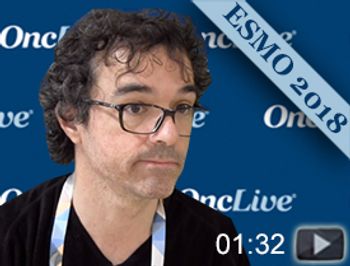
Fabrice André, MD, PhD, professor, Department of Medical Oncology, Institut Gustave Roussy, discusses the impact of the SOLAR-1 findings in breast cancer at the 2018 ESMO Congress.
Genetically engineered T-cells targeting a common tumor antigen appeared safe and demonstrated some evidence of antitumor activity in a first-in-human clinical evaluation.
When added to standard of care therapy, radiotherapy to the prostate improves overall survival in men newly diagnosed with metastatic prostate cancer who have a low metastatic disease burden.