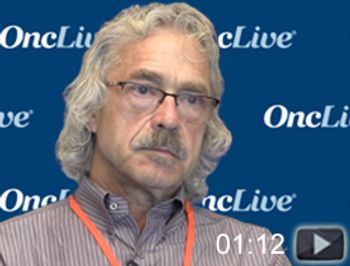
Miguel A. Villalona-Calero, MD, discusses the availability of ALK inhibitors for patients with ALK-positive non–small cell lung cancer and the importance of implementing sequencing panels to guide treatment.

Your AI-Trained Oncology Knowledge Connection!
Miguel A. Villalona-Calero, MD, discusses the availability of ALK inhibitors for patients with ALK-positive non–small cell lung cancer and the importance of implementing sequencing panels to guide treatment.

Nivolumab monotherapy demonstrated promising activity in a small number of patients with recurrent or metastatic cervical, vaginal, and vulvar cancer.
Two clinical trials evaluating blinatumomab compared with chemotherapy in pediatric patients with acute lymphoblastic leukemia were stopped early due to treatment benefit with the bispecific T-cell engager.

Hossein Borghaei, DO, discusses pivotal and ongoing trials driven by biomarkers in lung cancer.
Jeremy M. Force, DO, discussed current and emerging immunotherapy options and ongoing challenges in metastatic triple-negative breast cancer.
John M. Timmerman, MD, discusses the research being conducted across the spectrum of Hodgkin and non-Hodgkin lymphoma.

Matthew G. Mei, MD, discusses current considerations in the frontline management of advanced-stage Hodgkin lymphoma as well as ongoing investigations with checkpoint inhibitors and cellular-based therapy.

The European Medicines Agency's Committee for Medicinal Products for Human Use has recommended approval of nivolumab at a flat dosing schedule of either 240 mg over 30 minutes every 2 weeks, or 480 mg infused over 60 minutes every 4 weeks, for the adjuvant treatment of patients with melanoma who have involvement of lymph nodes or metastatic disease who have undergone complete resection.
Kanwarpal S. Kahlon, MD, discusses current treatment options for patients with aplastic anemia, immune thrombocytopenic purpura, and thrombotic thrombocytopenic purpura, as well as future research for the field.
Luis E. Raez, MD, discusses major trials in squamous NSCLC and what lies ahead for immunotherapy.

Andrew D. Zelenetz, MD, PhD, discusses the use of emerging targeted therapies in mantle cell lymphoma.
Konstantinos Leventakos, MD, discusses updates in personalized medicine for patients with stage III lung cancer.

Paul Kelly Marcom, MD, discusses the role of genomic testing in breast cancer.

Thought leaders from NYU Langone’s Perlmutter Cancer Center highlight the latest groundbreaking breast cancer research being conducted at their institution.
The addition of the antibody-drug conjugate brentuximab vedotin and the PD-1 inhibitor nivolumab to chemotherapy in patients with stage I/II Hodgkin lymphoma is under investigation in an ongoing phase II trial (NCT03233347).
Wayne A. Marasco, MD, PhD, discusses the intricacy of engineering CAR T cells and the early data he has observed with CAR T-cell therapy in renal cell carcinoma.

The European Commission has approved larotrectinib for the treatment of certain adult and pediatric patients with solid tumors who have an NTRK gene fusion without a known acquired resistance mutation.

City of Hope shares recent research grants and awards given to faculty at the institution.

The FDA has expanded the approval of the noninvasive colorectal cancer (CRC) screening test Cologuard to include eligible at-risk individuals ≥45 years.
The European Medicines Agency’s Committee for Medicinal Products for Human Use has recommended approval of gilteritinib as a single agent for the treatment of adult patients with relapsed/refractory acute myeloid leukemia who have FLT3 mutations.

The uptick of biosimilars has led to a surge of new data and regulatory decisions in recent years, with a focus on similarity between biosimilars and their reference products while reducing healthcare costs. This week, data on subcutaneous formulations of one biosimilar and long-term experience with another were provided, as well as an authorization of a trastuzumab (Herceptin) biosimilar in Canada.
Sarah M. Larson, MD, discusses trials with the potential to shift treatment strategies in the frontline and relapsed/refractory settings of multiple myeloma and remaining research questions in the field.

The European Medicines Agency’s Committee for Medicinal Products for Human Use has adopted a positive opinion to recommend approval of the combination of avelumab and axitinib for the frontline treatment of adult patients with advanced renal cell carcinoma.

Serial assessment of blood-based immune markers showed that the risk of progression from monoclonal gammopathy of undetermined significance, the precursor disease to multiple myeloma is fluctuating rather than determinate, and these patients can experience progression to myeloma within 5 years.

Gary J. Schiller, MD, discusses therapeutic advances, the importance of genomic testing, and other agents in the pipeline for acute myeloid leukemia.
Gastrointestinal oncology experts highlight what they are most excited for at the upcoming International Society of Gastrointestinal Oncology 16th Annual Gastrointestinal Oncology Conference.

Arek Z. Dudek, MD, PhD, discusses the research surrounding osimertinib in the treatment of patients with EGFR-positive non–small cell lung cancer.
Herbert A. Eradat, MD, explains how insight into the pathogenesis of chronic lymphocytic leukemia is leading to novel treatment strategies and shed light on unmet needs in the field.
Sylvia Adams, MD, discusses the biology of triple-negative breast cancer, data sparking excitement in the field, and intriguing trials on the horizon.

Christopher S. Seet, MD, PhD, discusses elements of treatment discontinuation in chronic myeloid leukemia.