

Hematologic Oncology
Latest News
March 1st 2021
BR Retains its Role in Frontline Waldenström Macroglobulinemia Despite the Utility of BTK Inhibitors
The treatment landscape of Waldenström macroglobulinemia is becoming increasingly complex with second-generation BTK inhibitors; however, the combination of bendamustine and rituximab remains the frontline standard of care for this patient population.
Advertisement
Latest Videos

CME Content































Advertisement
More News
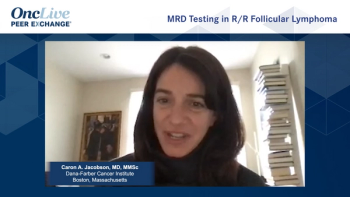
Drs Caron A. Jacobson and Krish Patel comment on NGS (next-generation sequencing) and MRD (minimal residual disease) testing in relapsed/refractory follicular lymphoma.
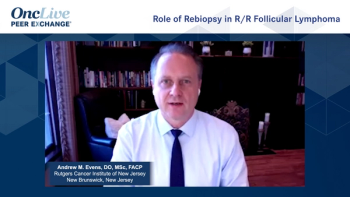
The rationale for rebiopsying patients who have relapsed/refractory follicular lymphoma and the types of molecular information that can be applied to treatment decisions.
Several options have emerged for patients with acute myeloid leukemia who are not candidates to receive chemotherapy, with venetoclax-based regimens chief among them.

Targeted therapies have helped to improve responses in patients with relapsed chronic lymphocytic leukemia regardless of high-risk disease, although optimal sequencing and toxicity management need to be further explored to strengthen the utilization of these options.

The FDA has approved melphalan flufenamide for use in combination with dexamethasone in the treatment of select adult patients with relapsed/refractory multiple myeloma.
Natural killer cells can offer several advantages over T cells for CAR therapy in that the former uses both a CAR dependent and independent mechanism for tumor eradication, has better safety, and off-the-shelf feasibility—all at a potentially lower cost.

High-dose chemotherapy and transplant remains the second-line standard of care for the majority of patients with relapsed/refractory diffuse large B-cell lymphoma; however, CAR T-cell therapy and other novel agents, which have transformed the third-line setting, may offer alternative and more personalized second-line options in the coming years.

Rituximab plus CHOP is not a suitable frontline treatment regimen for all patients with diffuse large B-cell lymphoma, explained Andre H. Goy, MD, who specified that patients with a high-risk International Prognostic Index, elderly patients, and patients with high-risk molecular subtypes require alternative treatment.

Kerry A, Rogers, MD, discusses the rationale behind the phase 1b study of VAY736 combined with ibrutinib in patients with chronic lymphocytic leukemia and the next steps for this research.
Mark Walters, MD, discusses the safety profile of betibeglogene autotemcel gene therapy in pediatric patients with transfusion-dependent β-thalassemia, as reported in the phase 3 Northstar-2 and Northstar-3 trials.
Jorge E. Cortes, MD, discusses future directions in the research of CPX-351 in patients with acute myeloid leukemia.

Srdan Verstovsek, MD, PhD, provides an overview of the similarities and differences between myeloproliferative neoplasms, including polycythemia vera, myelofibrosis, and essential thrombocythemia.
Experts provide insight on therapeutic approaches of myeloproliferative neoplasms, highlighting clinical trial data and disease characteristics of polycythemia vera, primary myelofibrosis, and essential thrombocythemia.
CD19-targeted CAR T-cell therapies have yielded durable remissions in approximately half of all patients with aggressive relapsed/refractory B-cell lymphomas.

Treatment with chimeric antigen receptor T cells has induced unprecedented overall response rates and complete response rates in patients with relapsed/refractory B cell malignancies.

Since the publication of the pivotal ELIANA trial in pediatric patients with acute lymphoblastic leukemia, the field of CAR T-cell therapy has grown significantly and left providers better equipped to understand and manage treatment-related adverse effects, such as cytokine release syndrome.

Andrew Ip, MD, MS, discusses the challenges of treating patients with hematologic malignancies and COVID-19.
Total body irradiation plus etoposide prior to hematopoietic stem cell transplantation resulted in improved overall survival and a lower risk of relapse in pediatric patients with high-risk acute lymphocytic leukemia compared with chemotherapy conditioning.
Timothy M. Schmidt, MD, discusses the integration and utility of bispecific antibodies in relapsed/refractory multiple myeloma, as well as some of the most promising agents in clinical development.
Paul G. Richardson, MD, reviews early data presented at ASH 2020 on the use of CELMoDs as well as melflufen for the management of RRMM.
Advertisement
Advertisement
Trending on OncLive
1
Single-Center, Retrospective Data Show Low Rate of Lifileucel Infusion Following Referral in Advanced Melanoma
2
Long-Term Cilta-Cel Data Show Low Rates of PFS Events in Standard-Risk R/R Myeloma
3
Real-World Data Support Clinical Benefit With Lifileucel in Previously Treated Advanced Melanoma
4
Dr Riedell on the Long-Term Efficacy of Tisa-Cel in R/R Follicular Lymphoma
5