

Lung Cancer
Latest News
Advertisement
Latest Videos
CME Content































Advertisement
More News
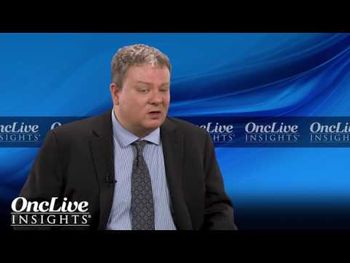
Anna Farago, MD, PhD, assistant, Medicine, Massachusetts General Hospital Cancer Center, and instructor, Medicine, at Harvard Medical School, discusses the combination of olarparib (Lynparza) and temozolomide (Temodar) for patients with small cell lung cancer (SCLC).
Veliparib failed to meet the primary endpoint in phase III non-small cell lung cancer and triple-negative breast cancer trials.
Jamie E. Chaft, MD, medical oncologist, Memorial Sloan Kettering Cancer Center, discusses pivotal ongoing clinical trials in the landscape of EGFR-mutant non–small cell lung cancer (NSCLC).

Leena Gandhi, MD, PhD, director of the Thoracic Medical Oncology Program at NYU Langone School of Medicine, discusses sequencing challenges as well as emerging agents in the field of ALK-positive non–small cell lung cancer (NSCLC).

Daniel B. Costa, MD, PhD, MMSc, associate professor of medicine at Harvard Medical School, medical staff, Hematology/Oncology, medical director of the Cancer Clinical Trials Office, and Medical Center Thoracic Oncology Group Leader, of Beth Israel Deaconess Medical Center, discusses biomarkers beyond PD-L1 in development for immunotherapy in patients with non–small cell lung cancer (NSCLC).
Julie R. Brahmer, MD, discusses the 5-year findings of nivolumab in non-small cell lung cancer, their significance, and expected next steps for this research.
Sukhmani Padda, MD discusses the status of ongoing clinical trials participating in this race to the frontline setting in lung cancer.
John V. Heymach, MD, PhD, chairman, Department of Thoracic/Head and Neck Medical Oncology, The University of Texas MD Anderson Cancer Center, discusses efficacy findings with nivolumab (Opdivo) results for patients with metastatic lung cancer.

The results of a recent prospective study demonstrate that circulating tumor cells can reveal disease recurrence an average of 6 months prior to conventional imaging in patients with locally advanced non–small cell lung cancer, findings that may help support the use of liquid biopsies to monitor high-risk patients in conjunction with screening.
Alectinib reduced the risk of disease progression or death compared with crizotinib as a frontline treatment for patients with ALK-positive non–small cell lung cancer, according to findings from the phase III ALEX trial.
Daniel Costin, MD, hematology and oncology, White Plains Hospital, discusses the potential with immunotherapy agents in the frontline setting as treatment for patients with non–small cell lung cancer (NSCLC).
John V. Heymach, MD, PhD, chairman, Department of Thoracic/Head and Neck Medical Oncology, The University of Texas MD Anderson Cancer Center, discusses the CheckMate-026 trial in lung cancer.
Leena Gandhi, MD, PhD, discusses emerging developments in the first-line treatment for patients with ALK-positive NSCLC, as well as novel agents emerging in the field.
Julie R. Brahmer, MD, associate professor of Oncology, Bloomberg Kimmel Institute for Cancer Immunotherapy at Johns Hopkins, discusses 5-year follow-up data from the CA209-003 study of nivolumab in previously treated advanced non-small cell lung cancer (NSCLC).
In findings from the phase III ALUR trial, alectinib significantly improved progression-free survival compared with chemotherapy in patients with ALK-positive non-small cell lung cancer who had progressed following treatment with platinum-based chemotherapy and crizotinib (Xalkori).
Advertisement
Advertisement
Trending on OncLive
1
Long-Term Cilta-Cel Data Show Low Rates of PFS Events in Standard-Risk R/R Myeloma
2
Single-Center, Retrospective Data Show Low Rate of Lifileucel Infusion Following Referral in Advanced Melanoma
3
Real-World Data Support Clinical Benefit With Lifileucel in Previously Treated Advanced Melanoma
4
Dr Riedell on the Long-Term Efficacy of Tisa-Cel in R/R Follicular Lymphoma
5