







Lung Cancer
Latest News
Advertisement
Latest Videos






CME Content































Advertisement
More News

The PD-L1 inhibitor atezolizumab was found to improve disease-free survival over best supportive care when used as an adjuvant treatment in patients with PD-L1–positive, stage II-IIIA non–small cell lung cancer, meeting the primary end point of the phase 3 IMpower010 trial.

Nasser H. Hanna, MD, discusses his approach to biomarker testing in lung cancer.

Benjamin P. Levy, MD, discusses the importance of testing for KRAS mutations in lung cancer.

Edgardo Santos, MD, FACP, discusses advances made with immunotherapy regimens in the first-line treatment of patients with metastatic non–small cell lung cancer and areas of active investigation.

Alexander Spira, MD, PhD, FACP, discusses the role of broad molecular testing in lung cancer.

Dr. Spira discusses the historical challenges of targeting KRAS, key findings from the phase 2 CodeBreaK 100 trial with sotorasib in KRAS G12C-mutant solid tumors, and the next steps of development for KRAS inhibitors in oncology.

Janakiraman Subramanian, MD, discusses the depth and durability of responses that have been reported with selpercatinib and pralsetinib, as well as ongoing research focused on improving outcomes and overcoming resistance mechanisms in RET fusion–positive NSCLC.

Lara A. Kujtan, MD, discusses the data that support the current utility of osimertinib in EGFR-mutant NSCLC and where else it is currently being explored.

Six indications for immune checkpoint inhibitors granted under the FDA’s accelerated approval process that later failed confirmatory clinical trials are being reassessed as the agency continues an industry-wide evaluation of the pathway.

The FDA has granted a fast track designation to poziotinib for use in previously treated patients with HER2 exon 20 mutations.
Dr. Levy discusses key research efforts with targeted therapies for patients with lung cancer who harbor NTRK, KRAS, and HER2 aberrations.

Melissa L. Johnson, MD, discusses the implications of recent advances made in the development of oncogenetargeted agents in non–small cell lung cancer.

Kaushal Parikh, MD, MBBS, highlights ongoing research exploring systemic approaches in early-stage non¬–small cell lung cancer and shares where future efforts are headed.

John Longshore, PhD, FACMG, discusses key molecular markers in metastatic lung cancer.

Theresa Boyle, MD, PhD, discusses the role of concurrent molecular testing in lung cancer.

The combination of canakinumab plus docetaxel failed to significantly improve overall survival in patients with locally advanced or metastatic non–small cell lung cancer whose disease has progressed while on, or after, prior platinum-based chemotherapy and a PD-L1 agent, missing the primary end point of the phase 3 CANOPY-2 trial.

The FDA has approved the VENTANA ALK CDx assay as a companion diagnostic to identify patients with ALK-positive non–small cell lung cancer who are eligible to receive treatment with lorlatinib.

Panelists provide first impressions on recent clinical trials in the treatment of small cell lung cancer and comment on the safety and efficacy of study treatments.
Key opinion leaders provide insights on chemotherapy and radiotherapy in patients with unresectable, locally advanced non–small cell lung cancer (NSCLC).
Experts in thoracic oncology discuss the role of single-agent immunotherapy as neoadjuvant therapy and comment on the viability of MPR [major pathologic response] as a surrogate endpoint for non–small cell lung cancer (NSCLC).

Poziotinib, when given at a daily dose of 16 mg, was found to demonstrate clinically meaningful activity when used in treatment-naïve patients with metastatic non–small cell lung cancer who harbor EGFR exon 20 mutations.
John V. Heymach, MD, PhD, discusses the incidence of EGFR exon 20 insertions in lung cancer, diagnostic challenges of identifying EGFR exon 20 insertions, and data from the International Association for the Study of Lung Cancer 2020 World Conference on Lung Cancer with mobocertinib and amivantamab in this patient subset.

Treatment strategies for patients with advanced-stage non–small cell lung cancer have shifted away from platinum-based doublet chemotherapy and toward combination strategies that include immune checkpoint inhibitors.
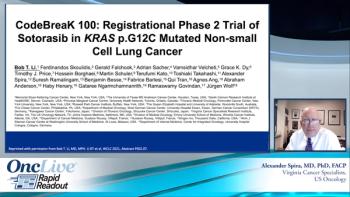
Alexander Spira, MD, PhD, FACP, presents slides from the International Association for the Study of Lung Cancer 2020 World Conference on Lung Cancer (WCLC) from CodeBreak 100, the phase 2 trial of sotorasib in KRASG12C-mutated non–small cell lung cancer.
The FDA has expanded the indication for lorlatinib to include the frontline treatment of patients with ALK-positive non–small cell lung cancer.
Advertisement
Advertisement
Trending on OncLive
1
Long-Term Cilta-Cel Data Show Low Rates of PFS Events in Standard-Risk R/R Myeloma
2
Single-Center, Retrospective Data Show Low Rate of Lifileucel Infusion Following Referral in Advanced Melanoma
3
Real-World Data Support Clinical Benefit With Lifileucel in Previously Treated Advanced Melanoma
4
Dr Riedell on the Long-Term Efficacy of Tisa-Cel in R/R Follicular Lymphoma
5