






Lung Cancer
Latest News
Advertisement
Latest Videos






CME Content































Advertisement
More News

Michael Shafique, MD, discusses treatment considerations for selecting between selpercatinib and pralsetinib in RET fusion–positive non–small cell lung cancer.

Edward S. Kim, MD, highlights the impact of osimertinib in the treatment of patients with EGFR-mutant non–small cell lung cancer, next steps with the agent, and the importance of early genetic testing to provide personalized care.

Marianne Davies, NP, DNP, MSN, BSN, discussed the potential severity of immune-related adverse effects and detailed recommended management strategies for patients receiving checkpoint inhibitors, especially in lung cancer.

Molecular Testing Results Are Critical Amid an Expanding Targeted Therapy Paradigm in Advanced NSCLC
Julia K. Rotow, MD, discusses how she approaches molecularly testing in patients with liquid- and tissue-based biopsies, the importance of waiting to initiate immunotherapy until a patient’s molecular testing results are confirmed, and other nuances that she considers when treating patients with advanced non–small cell lung cancer.

Christopher G. Azzoli, MD, discusses the importance of identifying molecular aberrations prior to starting a patient with advanced non–small cell lung cancer on immunotherapy, ongoing research aimed at furthering the immunotherapy paradigm, and explained why novel biomarkers of response to immunotherapy are needed.

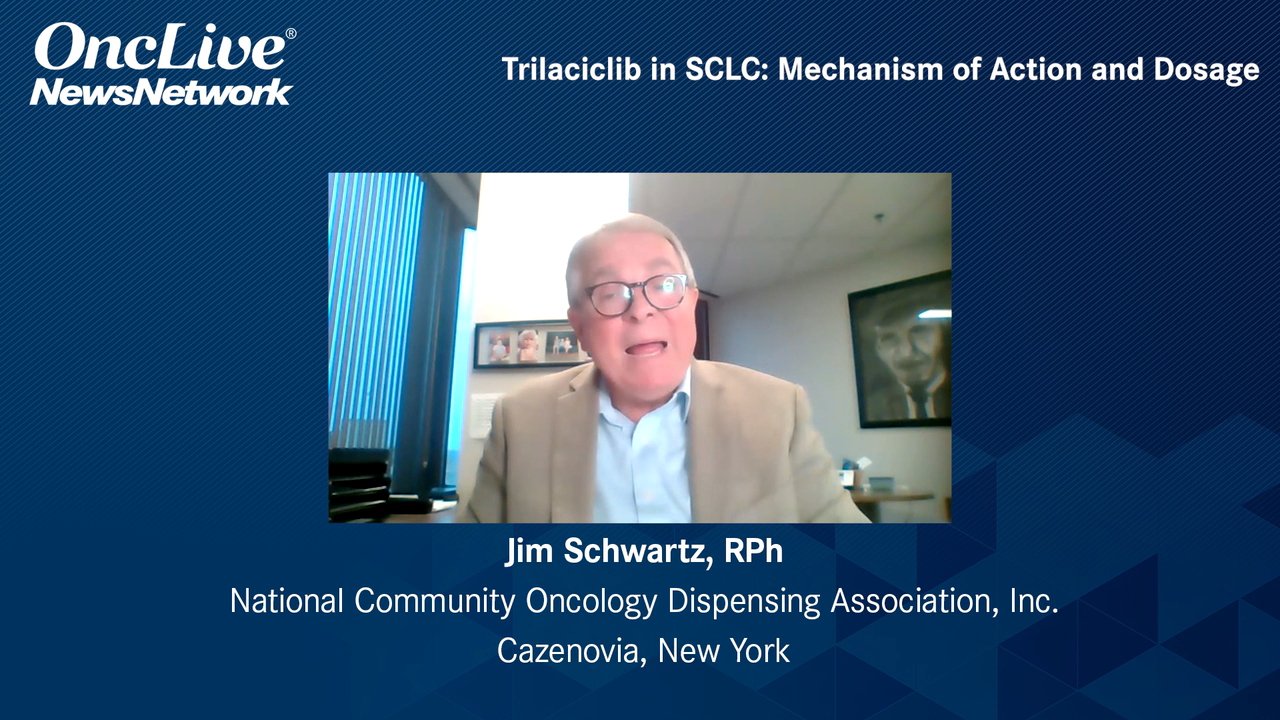
Lowell L. Hart, MD, discusses trilaciclib’s unique role in patients with ES-SCLC who experience myelosuppression, as well as the future role of the agent.

Jose Pacheco, MD, discusses the mechanism of action of trastuzumab deruxtecan in patients with HER2-overexpressing metastatic non–small cell lung cancer.

Stephen Liu, MD, discusses common NRG1 fusion partners in patients with non–small cell lung cancer.

Vamsidhar Velcheti, MD, discusses the importance of real-world data for patients with non–small cell lung cancer.

The FDA has granted a priority review designation to a new drug application for mobocertinib for the treatment of adult patients with EGFR exon 20 insertion mutation–positive metastatic non–small cell lung cancer, as detected via an FDA-approved assay, who have received previous platinum-based chemotherapy.

Roy H. Decker, MD, PhD, discusses the use of pembrolizumab with concurrent chemoradiotherapy in patients with inoperable, locally advanced non–small cell lung cancer.

The National Comprehensive Cancer Network® has added the CDK4/6 inhibitor trilaciclib to its Clinical Practice Guidelines in Oncology for small cell lung cancer as well as for supportive care for hematopoietic growth factors.

Nisha A. Mohindra, MD, discusses the impact of the FDA approval of lurbinectedin in the treatment of patients with small cell lung cancer.

The European Medicines Agency’s Committee for Medicinal Products for Human Use has recommended osimertinib for the adjuvant treatment of adult patients with stage IB, II, or IIIA EGFR-mutated non–small cell lung cancer following complete tumor resection with curative intent.

The European Medicines Agency’s Committee for Medicinal Products for Human Use has recommended the combination of nivolumab and ipilimumab as a frontline treatment for adult patients with unresectable malignant pleural mesothelioma.

This article summarizes key data presented during a virtual OncLive® Scientific Interchange & Workshop in which oncologists who specialize in lung cancer treatment discussed their practices for HER2 testing and the potential role of emerging antibody-drug conjugates and novel HER2-targeted small-molecule tyrosine kinase inhibitors for treatment of HER2-altered NSCLC.
Drs Joshua M. Bauml and Benjamin Levy highlight more common adverse events associated with MET inhibitors used to treat MET exon 14 skipping mutations in non–small cell lung cancer and share strategies to help manage patients on therapy.
A comparison between the MET inhibitors available to treat MET exon 14 skipping mutations in non–small cell lung cancer and factors that should be considered when selecting a type 1 or type 2 MET-directed therapy.

Jyoti D. Patel, MD, discusses the evolving use of osimertinib in EGFR-mutant NSCLC and emerging targeted agents for patients with EGFR exon 20 insertion mutations.

Kristen Marrone, MD, discusses the evolving role of postoperative radiotherapy in early-stage non–small cell lung cancer and ongoing trials examining the use of immunotherapy and targeted agents in patients with unresectable stage III disease.

Missak Haigentz Jr., MD, discusses the importance of adjuvant osimertinib in EGFR-positive non–small cell lung cancer.

Jacob Sands, MD, discussed current approaches to the treatment of patients with early-stage and locally advanced non–small cell lung cancer.

Although anticancer therapies that leverage T cells have commanded the most attention in the immuno-oncology era of the past decade, strategies based on natural killer cells have recently emerged as attractive approaches.

The combination of atezolizumab, carboplatin, and etoposide, as well as durvalumab, etoposide, and platinum chemotherapy, each have shown survival improvements vs chemotherapy alone as frontline therapy in patients with extensive-stage small cell lung cancer.

Postoperative survival after surgery for spinal metastases has improved over the past 20 years, particularly in patients with kidney, breast, lung, and colon tumors metastatic to the spine.
Advertisement
Advertisement
Trending on OncLive
1
Single-Center, Retrospective Data Show Low Rate of Lifileucel Infusion Following Referral in Advanced Melanoma
2
Long-Term Cilta-Cel Data Show Low Rates of PFS Events in Standard-Risk R/R Myeloma
3
Real-World Data Support Clinical Benefit With Lifileucel in Previously Treated Advanced Melanoma
4
Dr Riedell on the Long-Term Efficacy of Tisa-Cel in R/R Follicular Lymphoma
5