






Multiple Myeloma
Latest News
Advertisement
Latest Videos





CME Content































Advertisement
More News
An expert discusses the stigmas behind clinical trials and the shockingly low rate of enrollment by Black Americans with multiple myeloma.
Dr Craig Cole explains why awareness about multiple myeloma needs to be raised in Black American communities by healthcare workers.
Barry Paul, MD, discusses the emerging benefits of integrating CAR T-cell therapy into treatment paradigms for patients with relapsed/refractory multiple myeloma.

Peter Voorhees, MD, highlights important topics that his colleagues discussed at the meeting, including the important role of up-front autologous stem cell transplant and distinct adverse effects to be aware of when using different CAR T-cell therapies.

Shebli Atrash, MD, discusses the development and current use of BCMA-targeted antibody-drug conjugates and CAR T-cell therapies for the treatment of patients with multiple myeloma.

Peter Voorhees, MD, discusses key points from his presentation on proteasome inhibitors in multiple myeloma and positive data with the agents in the transplant-eligible and transplant-ineligible populations.
Experts on multiple myeloma share comprehensive insight on how to build better access to specialty care for patients of racial and ethnic minority groups.
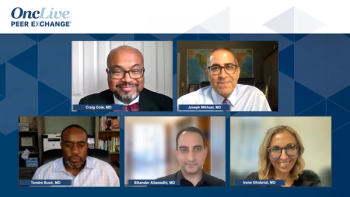
Expert perspectives on how to improve the early detection of multiple myeloma within patients belonging to racial and ethnic minority groups.
Craig Cole, MD, describes the barriers that can affect the diagnosis of multiple myeloma.
Joseph Mikhael, MD, introduces the topic of disparities in multiple myeloma and the concept of multicultural health care.

Dr Brentjens discussed targeting the “enigmatic” GPRC5D protein, safety results with MCARH109, and the appropriate sequencing for the agent.
Closing out their review of the barriers racial and ethnic minority groups encounter in receiving care, expert panelists address access to transplantation or novel therapy.
Comprehensive discussion on access to specialized care and how racial and ethnic minority groups encounter barriers in this setting.

MCARH109, a CAR T-cell therapy targeting the “enigmatic” GPRC5D antigen, generated remissions in 70.6% of patients with relapsed/refractory multiple myeloma.

Belantamab mafodotin plus lenalidomide and dexamethasone showed durable responses in patients with relapsed/refractory multiple myeloma.
Panelists address how racial and ethnic minority groups experience disparity in time to diagnosis within the multiple myeloma treatment pathway.
Expert panelists shift their attention to how social determinants of multiple myeloma impact the treatment received by racial and ethnic minority groups.
Focused discussion on the biological determinants of multiple myeloma and how its prevalence is reflected in racial and ethnic minority groups.
Joseph Mikhael, MD, spearheads an overview on the prevalence of multiple myeloma in racial and ethnic minority groups in the context of health equity.

In a 14 to 2 vote, the FDA’s Oncologic Drugs Advisory Committee voted that the benefit-risk profile of melphalan flufenamide is not favorable for the approved indicated population of patients with relapsed/refractory multiple myeloma.
The BCMA-directed CAR T-cell therapy zevorcabtagene autoleucel demonstrated a 100% objective response rate in heavily pretreated patients with relapsed/refractory multiple myeloma
Drs Lipe and Forsberg share advice for community oncologists and highlight unmet needs in the management of multiple myeloma.
Drs Forsberg and Lipe discuss strategies for sequencing therapies in relapsed/refractory multiple myeloma.
Peter Forsberg, MD, offers insight into which patients with multiple myeloma are most suitable for treatment with the DARA-Kd regimen.
Brea Lipe, MD, and Peter Forsberg, MD, review the results of the CANDOR trial evaluating DARA-Kd regimen in R/R multiple myeloma.
Advertisement
Advertisement
Trending on OncLive
1
Long-Term Cilta-Cel Data Show Low Rates of PFS Events in Standard-Risk R/R Myeloma
2
FDA Updates Axi-Cel Label to Remove Limitation of Use in R/R PCNSL
3
Real-World Data Support Clinical Benefit With Lifileucel in Previously Treated Advanced Melanoma
4
Single-Center, Retrospective Data Show Low Rate of Lifileucel Infusion Following Referral in Advanced Melanoma
5