






Prostate Cancer
Latest News

Advertisement
Latest Videos






CME Content































Advertisement
More News

Philip J. Buffington, MD, chief medical officer, The Urology Group, discusses MRI fusion-guided biopsy in patients with prostate cancer.

Up to 94% of patients with metastatic castration-resistant prostate cancer have circulating tumor DNA with at least 1 genetic alteration, suggesting ctDNA could be a noninvasive alternative to traditional tumor biopsies and help personalize treatment in this setting.

David Albala, MD, urologist and medical director, Associated Medical Professionals, discusses patients with prostate cancer who are best suited to be treated with robotic surgery.
Howard I. Scher, MD, chief, Genitourinary Oncology Service, Memorial Sloan Kettering Cancer Center, discusses the potential that liquid biopsies will have in the treatment landscape of prostate cancer.

Richard Harris, MD, urologist, UroPartners, discusses the respective roles of PSA testing and active surveillance in the treatment of patients with prostate cancer.

The addition of hormonal therapy to radiation treatment following surgery significantly improved survival in patients with recurrent prostate cancer, according to the results of a study published in The New England Journal of Medicine.
Wassim Abida, MD, PhD, Memorial Sloan Kettering Cancer Center, discusses the future of hormonal therapy in prostate cancer.

A prostate-specific antigen nadir greater than 0.5 ng/mL following radiation and androgen deprivation therapy seems to identify men prior to PSA failure who are at high-risk for death, and would thus require more aggressive treatment for their prostate cancer.
Philip W. Kantoff, MD, chair of the Department of Medicine, Memorial Sloan Kettering Cancer Center and a 2014 Giants of Cancer Care winner for Genitourinary Cancer, discusses the combination of docetaxel (Taxotere) chemotherapy and androgen deprivation therapy (ADT) in the setting of metastatic hormone-sensitive prostate cancer.

Dana E. Rathkopf, MD, Memorial Sloan Kettering Cancer Center, discusses the emergence of the androgen receptor splice variant-7 (AR-V7) biomarker in the treatment of patients with prostate cancer.

Mark Stein, MD, medical oncologist, Rutgers Cancer Institute of New Jersey, discusses androgen receptor–resistance in prostate cancer.
David Albala, MD, discusses the uses and benefits of robotic urological surgery in prostate cancer, as well as methods to achieve better physician compliance.
Richard Harris, MD, urologist, UroPartners, discusses PSA testing for patients with prostate cancer and the controversial grade D recommendation of the United States Task Force.

William K. Oh, MD, chief, Division of Hematology and Medical Oncology, professor of Medicine and Urology, Mount Sinai School of Medicine, discusses the challenges that remain with the use of docetaxel to treat patients with prostate cancer.
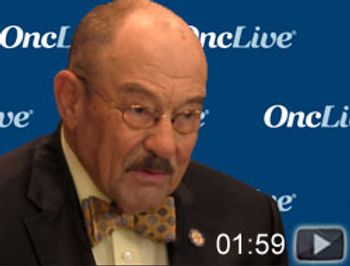
Carl Olsson, MD, Integrated Medical Professionals, compares the efficacy of LHRH agonists with antagonists, which are commonly used to treat patients with prostate cancer.
A sharp decline has been observed in the overall rate of men receiving treatment for prostate cancer.

Mark Stein, MD, medical oncologist, Rutgers Cancer Institute of New Jersey, discusses commercial tests for determining therapies for patients with prostate cancer.

Robert Dreicer, MD, associate director for clinical research and deputy director of the University of Virginia Cancer Center, discusses the questions that surround radium-223.

Rahul Tendulkar, MD, associate staff, Radiation Oncology, Cleveland Clinic, discusses post-prostatectomy radiation therapy and its impact on reducing prostate cancer mortality.

Philip J. Buffington, MD, chief medical officer, The Urology Group, discusses effective prostate cancer screening methods and when to use active surveillance.

David Albala, MD, urologist and medical director, Associated Medical Professionals, discusses the benefits associated with robotic surgery in the treatment of patients with prostate cancer.

William Oh, MD, discusses the continued significant of docetaxel in advanced prostate cancer.

Robert Dreicer, MD, associate director for Clinical Research and deputy director of the University of Virginia Cancer Center, discusses novel agents or clinical trials in development designed to help guide treatment decisions for patients with prostate cancer.
In 1941, Charles Brenton Huggins, MD, observed that prostate cancer could be controlled by hormone-directed treatments, a discovery for which he was awarded half the Nobel Prize in Physiology or Medicine in 1966.

Bryan Mehlhaff, MD, medical director of research for Oregon Urology Institute, discusses the ways in which the treatment landscape in prostate cancer has evolved in recent years.
Advertisement
Advertisement
Trending on OncLive
1
Long-Term Cilta-Cel Data Show Low Rates of PFS Events in Standard-Risk R/R Myeloma
2
Nonresponse to Bridging Therapy and Peak ALC After Cilta-Cel Are Associated With Neurotoxicity, NRM in Myeloma
3
FDA Updates Axi-Cel Label to Remove Limitation of Use in R/R PCNSL
4
Real-World Data Support Clinical Benefit With Lifileucel in Previously Treated Advanced Melanoma
5