






Breast Cancer
Latest News

Advertisement
Latest Videos







CME Content































Advertisement
More News

As longer-term follow-up data become available for several agents approved for HER2-positive metastatic breast cancer, investigators are looking closely at the characteristics of patients enrolled in those clinical trials to determine appropriate treatment strategies in the third-line setting and beyond.

Neratinib in combination with fulvestrant was active in heavily pretreated patients with estrogen receptor-positive, metastatic breast cancer, although the clinical benefit rate did not meet the predefined efficacy criteria.

Treatment with TAS-117, a highly potent and selective oral allosteric pan-v-akt murine thymoma viral oncogene homolog inhibitor, demonstrated some clinical efficacy in patients with ovarian cancer harboring PIK3CA E545K mutations and in those with breast cancer harboring PIK3CA H1047R and Akt1E17K mutations.

Paz Polak, PhD, discusses research that evaluated cancer genomes in Ghana through the use of liquid biopsies.

Thomas Urban Marron, MD, PhD, discusses primary objectives of a study examining the use of an adjuvant personalized neoantigen peptide vaccine in several malignancies.

Jane L. Meisel, MD, discusses sequencing questions, tucatinib combinations under exploration, and emerging strategies for use in the treatment of patients with HER2-positive breast cancer.
The FDA has granted a regular approval to sacituzumab govitecan for the treatment of patients with unresectable locally advanced or metastatic triple-negative breast cancer who have previously received 2 or more systemic therapies, at least 1 of them for metastatic disease.

The coronavirus disease 2019 pandemic had a tremendous impact on the surgical care of patients with breast cancer; practice patterns needed to be rapidly adjusted to continue to safely provide care during a time when resources were very limited.

An examination of the real-world data supporting the use of tucatinib for patients with metastatic HER2+ breast cancer in Europe.

Experts in breast oncology review the favorable safety profile of tucatinib for patients with metastatic HER2+ breast cancer.
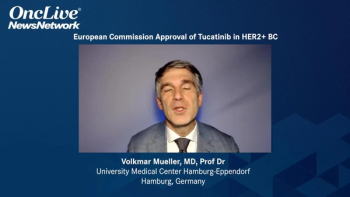
Volkmar Mueller, MD, reviews recent data from the HER2CLIMB trial and discusses the recent regulatory approval in Europe for patients with HER2+ breast cancer.

Jane L. Meisel, MD, discusses managing toxicities associated with ado-trastuzumab emtansine in patients with HER2-positive breast cancer.

Chemoimmunotherapy has become the standard of care for the frontline treatment of patients with PD-L1–positive, locally advanced or metastatic triple-negative breast cancer. However, understanding which patients will derive the most benefit from the approach is in need of further exploration

Optimal patient selection and duration of therapy are the 2 biggest areas to tackle regarding CDK4/6 inhibition in the adjuvant setting of estrogen receptor–positive breast cancer.

Although trastuzumab-based regimens remain the standard treatment for patients with early-stage HER2-positive breast cancer, unanswered clinical questions surround the use of other agents in the neoadjuvant and adjuvant settings.

Data from the pivotal phase 3 KATHERINE has led to the addition of ado-trastuzumab emtansine to the HER2-positive breast cancer treatment arsenal, but the toxicities associated with the approach must be appropriately managed so that patients can continue to receive it.
Although endocrine therapies have revolutionized the treatment of breast cancers driven by the estrogen receptor, the development of resistance remains a major challenge that limits long-term remission with currently available drugs.
The Marshalls go beyond the pages of their new memoir, Off Our Chests: A Candid Tour Through the World of Cancer, to discuss how Liza's diagnosis of triple-negative breast cancer changed their lives and the key messages they hope readers will take from their book.
Digital media, now more than ever, has become a primary platform for communication, and in 2020, the production of the OncLive® podcast, OncLive On Air™, was put into overdrive to bring practicing oncologists exclusive biweekly interviews, discussions, and insights from leading experts in cancer care.
A new drug application has been submitted to the FDA and the China National Medical Products Administration for the use of plinabulin plus granulocyte colony-stimulating factor for the prevention of chemotherapy-induced neutropenia.

A biologics license application has been submitted to the FDA for the approval of F-627 as a treatment option for patients with breast cancer who have chemotherapy-induced neutropenia.

Kevin Kalinsky, MD, MS, discusses the potential role of ovarian function suppression in hormone receptor–positive, HER2-negative breast cancer.

Faculty from the Miami Breast Cancer Conference® discuss how to apply the RxPONDER data to clinical practice.

Julia R. White, MD, discusses research with regional nodal irradiation in node-positive breast cancer.
The FDA has issued a complete response letter to Merck stating that regulatory decision for the supplemental biologics license application seeking approval for pembrolizumab for use in patients with high-risk, early-stage triple-negative breast cancer plus chemotherapy as neoadjuvant treatment, then continuing as a single agent as adjuvant treatment following surgery, should be deferred.
Advertisement
Advertisement
Trending on OncLive
1
Long-Term Cilta-Cel Data Show Low Rates of PFS Events in Standard-Risk R/R Myeloma
2
FDA Updates Axi-Cel Label to Remove Limitation of Use in R/R PCNSL
3
Real-World Data Support Clinical Benefit With Lifileucel in Previously Treated Advanced Melanoma
4
Nonresponse to Bridging Therapy and Peak ALC After Cilta-Cel Are Associated With Neurotoxicity, NRM in Myeloma
5