







Hematologic Oncology
Latest News
Advertisement
Latest Videos



CME Content































Advertisement
More News

Dr Andreeff discusses the evaluation of uproleselan for the treatment of patients with acute myeloid leukemia, the rationale for targeting E-selectin in patients with this disease, how uproleselan could amplify the effects of chemotherapy in the treatment of these patients.

Japan’s Ministry of Health, Labour, and Welfare has approved quizartinib in combination with standard cytarabine and anthracycline induction and standard cytarabine consolidation and as maintenance monotherapy in patients with newly diagnosed acute myeloid leukemia whose tumors harbor FLT3-ITD mutations.

Expert hematologist-oncologist Grzegorz Nowakowski, MD, reviews data from the 5-year analysis of the L-MIND study combining tafasitamab with lenalidomide in relapsed/refractory diffuse large B-cell lymphoma.

Voruciclib monotherapy and in combination with venetoclax demonstrated clinical activity and was well tolerated with no significant myelosuppression in heavily pretreated patients with relapsed/refractory acute myeloid leukemia or B-cell malignancies, according to initial data from a phase 1 trial.

For the 11th consecutive year, OncLive is honored to recognize oncology leaders whose innovations have contributed to immeasurable improvements in outcomes for countless patients.

Tycel Phillips, MD, discusses the significance of the FDA approval of the bispecific antibody epcoritamab in patients with relapsed/refractory diffuse large B-cell lymphoma.

Mitchell E. Horwitz, MD, expands on key efficacy and safety data supporting the FDA approval of omidubicel, the significance of this decision for the blood cancer treatment paradigm, and the need for continued investigation of the agent in non-malignant disease and other patient subgroups.
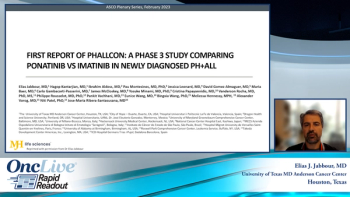
First Report of PhALLCON: A Phase 3 Study Comparing Ponatinib vs Imatinib in Newly Diagnosed Ph+ ALL
Expert Elias Jabbour, MD, reviews clinical data from the PhALLCON study of ponatinib vs imatinib in patients with Ph+ acute lymphocytic leukemia and considers its clinical implications.

Roxadustat proved to be noninferior to recombinant erythropoietin alfa with regard to change in hemoglobin level from baseline to an average level during weeks 9 to 13 in patients receiving concurrent chemotherapy for non-myeloid malignancies in China, meeting the primary end point of an ongoing phase 3 trial.

Dr Horwitz discusses the FDA approval of omidubicel in patients with blood cancers, key efficacy and safety data from the pivotal phase 3 trial, and the benefits omidubicel provides beyond improved neutrophil engraftment.
The European Commission has approved ivosidenib tablets in combination with azacitidine for the treatment of adult patients with newly diagnosed acute myeloid leukemia with an IDH1 R132 mutation who are not eligible to receive standard induction chemotherapy, and as monotherapy for the treatment of adult patients with locally advanced or metastatic cholangiocarcinoma with an IDH1 R132 mutation who received at least 1 prior line of systemic therapy.

The phase 3 MATTERHORN trial examining roxadustat as an anemia treatment in patients with transfusion-dependent, lower-risk myelodysplastic syndrome did not meet its primary end point.

The FDA has granted a priority review to the supplemental biologics license application seeking to expand the current indication of luspatercept to include treatment of anemia in patients with very low- to intermediate-risk myelodysplastic syndrome who have not previously received erythropoiesis-stimulating agents and who may require red blood cell transfusions.

Iptacopan elicited improved hemoglobin levels measuring at least 2 g/dL higher vs baseline, leading to transfusion independence after 24 weeks in approximately 92.2% of patients with complement inhibitor–naïve paroxysmal nocturnal hemoglobinuria.

The PD-L1 inhibitor sugemalimab produced durable responses with a tolerable safety profile in patients with relapsed/refractory natural killer/T-cell lymphoma, according to findings from a preplanned primary analysis of the multicenter, single-arm, phase 2 GEMSTONE-201 trial.
The FDA has extended the review period for a new drug application for quizartinib in combination with standard cytarabine and anthracycline induction and standard cytarabine consolidation chemotherapy, and as continuation monotherapy following consolidation, for the treatment of newly diagnosed adult patients with FLT3-ITD–positive acute myeloid leukemia.

To evaluate the prevalence of financial toxicity and observe the effect of Coverage and Cost-of-Care Links, a program providing financial navigation, investigators initiated a nonrandomized study.

Michael Andreeff, MD, PhD, discusses the rationale for investigating uproleselan plus venetoclax and azacitidine in patients with acute myeloid leukemia.

Brian C. Ball, MD, discusses previous research on tamibarotene in newly diagnosed acute myeloid leukemia, and how these data support the ongoing phase 2 SELECT-AML-1 trial.

An independent data monitoring committee has recommended that the phase 3 REGAL trial examining galinpepimut-S in patients with acute myeloid leukemia continue as planned without modifications.

Mitchell E. Horwitz, MD, discusses the significance of omidubicel as an FDA-approved treatment option to reduce the risk of infection in patients with blood cancers and highlights key findings from the pivotal phase 3 trial.

The FDA has approved omidubicel-onlv (Omisirge) to quicken the recovery of neutrophils in the body and reduce the risk of infection in adults and pediatric patients aged 12 years and older with blood cancers who are slated to undergo umbilical cord blood transplantation after a myeloablative conditioning regimen.

The combination of tafasitamab and lenalidomide followed by tafasitamab maintenance prolonged responses in patients with relapsed/refractory diffuse large B-cell lymphoma.

Bradley W. Christensen, MD, discusses the process of patient selection for BCL-2 induction therapy in patients with acute myeloid leukemia in accordance with their individual disease characteristics.
The FDA has placed a partial clinical hold on a phase 1 trial investigating MT-0169 in patients with relapsed/refractory multiple myeloma or non-Hodgkin lymphoma.
Advertisement
Advertisement
Trending on OncLive
1
Long-Term Cilta-Cel Data Show Low Rates of PFS Events in Standard-Risk R/R Myeloma
2
Real-World Data Support Clinical Benefit With Lifileucel in Previously Treated Advanced Melanoma
3
FDA Updates Axi-Cel Label to Remove Limitation of Use in R/R PCNSL
4
Dr Riedell on the Long-Term Efficacy of Tisa-Cel in R/R Follicular Lymphoma
5