






Lung Cancer
Latest News
Advertisement
Latest Videos




CME Content































Advertisement
More News

James Stevenson, MD, discusses the importance of early screening in lung cancer.

Jay M. Lee, MD, discusses the implications of the ADAURA trial in early-stage resectable NSCLC, the importance of molecular testing, and the need for a multidisciplinary approach in this population.
Despite an outsized reputation fueled by late-night commercials from personal injury lawyers, mesothelioma is a rare disease with approximately 3000 new diagnoses every year in the United States.

The addition of veliparib to platinum-based chemotherapy in the frontline treatment of current smokers with advanced squamous non–small cell lung cancer did not significantly improve overall survival, but the LP52 signature may identify a subset of patients who will derive benefit from the combination.

Nivolumab followed by tumor-infiltrating lymphocyte therapy and maintenance nivolumab demonstrated a suitable safety profile and antitumor activity in patients with metastatic non–small cell lung cancer.

Pradnya D. Patil, MD, FACP, discusses recent developments with targeted therapies in lung cancer.
Edward Chu, MD, MMS, discusses ongoing efforts to address disparities in lung cancer at Montefiore and Albert Einstein College of Medicine.
The discussion about the evolution of precision medicine in non–small cell lung cancer (NSCLC) ends as each expert discusses their final thoughts.
Panelists conclude their discussion by commenting on areas of unmet need and sharing personal perspectives on factors that may change clinical practice for SCLC in the future.
Key opinion leaders in lung cancer share personal thoughts on the potential for bispecific agents and the overall impact of inhibiting molecular targets.
Oncology experts provide insight on screening methods available and discuss strategies that may address challenges in identification of targetable mutations/tumor profiles in non–small cell lung cancer (NSCLC).

Jonathan W. Goldman, MD, discusses key takeaways from the phase 3 CASPIAN trial in patients with extensive-stage small cell lung cancer.

Martin Dietrich, MD, PhD, shares how he navigates the non–small cell lung cancer (NSCLC) treatment landscape.
Final takeaways from ASCO 2021 and the use of immunotherapy to treat various types of patients with non–small cell lung cancer.
The potential clinical utility of blood-based biomarkers in non–small cell lung cancer based on recent data presented at ASCO 2021.
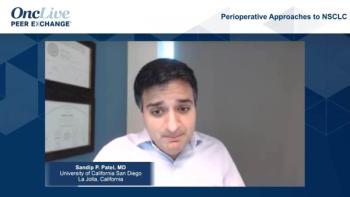
Drs Chaitali Nangia and Sandip P. Patel debate between best treatment approaches for patients with non–small cell lung cancer in the perioperative setting.
Chad V. Pecot, MD, discusses addressing mechanisms of resistance with new targeted therapies in non–small cell lung cancer.

James Stevenson, MD, discusses ongoing research efforts that are generating excitement in extensive-stage small cell lung cancer.

Computed tomography-based image guidance during radiation therapy could be a method of identifying patients who require a complete workup for COVID-19.
Jonathan Spicer, MD, PhD, discusses the efficacy observed with neoadjuvant nivolumab plus platinum-doublet chemotherapy in patients with resectable non–small cell lung cancer.
The addition of toripalimab to chemotherapy resulted in a significant improvement in progression-free survival compared with chemotherapy alone when given as first-line treatment in patients with non–small cell lung cancer, meeting the primary end point of the phase 3 CHOICE-01 trial.

Nivolumab followed by treatment with tumor-infiltrating lymphocytes was generally safe and found to have clinical benefit in patients with metastatic non–small cell lung cancer.
An overview of TKIs in ROS1-rearranged non–small cell lung cancer (NSCLC) and updated trial results that were presented at the American Society of Clinical Oncology (ASCO) 2021 annual meeting.
Recommendations for EGFR testing in patients with non–small cell lung cancer based on the wide heterogeneity of these mutations.
Mark A. Socinski, MD, highlights the targeted agents available to treat non–small cell lung cancer with EGFR mutations.
Advertisement
Advertisement
Trending on OncLive
1
Long-Term Cilta-Cel Data Show Low Rates of PFS Events in Standard-Risk R/R Myeloma
2
Nonresponse to Bridging Therapy and Peak ALC After Cilta-Cel Are Associated With Neurotoxicity, NRM in Myeloma
3
FDA Updates Axi-Cel Label to Remove Limitation of Use in R/R PCNSL
4
Real-World Data Support Clinical Benefit With Lifileucel in Previously Treated Advanced Melanoma
5