






Hematologic Oncology
Latest News
Advertisement
Latest Videos




CME Content































Advertisement
More News

Subcutaneous epcoritamab produced deep and durable complete remissions in patients with relapsed or refractory large B-cell lymphoma, with complete responders having favorable long-term outcomes, according to updated data from the phase 1/2 EPCORE NHL-1 trial.

The addition of quizartinib to induction and consolidation chemotherapy, followed by single-agent quizartinib for up to 36 cycles, improved survival outcomes vs placebo in patients with FLT3 ITD–mutated, newly diagnosed acute myeloid leukemia.

Developing an optimal treatment strategy for patients with accelerated- or blast-phase myeloproliferative neoplasms requires consideration of a patient's ability to tolerate intensive induction therapy, their eligibility for allogeneic stem cell transplant.

Investigating the addition of novel agents to cytotoxic chemotherapy may help prevent relapse in patients with T-cell acute lymphoblastic leukemia by bolstering the efficacy of these standard frontline therapies.
Before closing out their discussion on first-line management of follicular lymphoma, experts consider the importance of patient monitoring and discuss the diminished role of maintenance therapy.
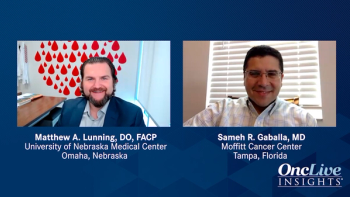
Sameh Gaballa, MD, and Matthew Lunning, DO, FACP, review the frontline treatment armamentarium available to patients with follicular lymphoma.

No difference in relapse-free survival or non–relapse mortality was seen with intensive vs non-intensive consolidation chemotherapy regimens prior to allogeneic hematopoietic stem cell transplantation in elderly patients over the age of 60 with acute myeloid leukemia in first complete remission.

Hagop M. Kantarjian, MD, discusses the predictive value of early landmark cytogenetic or molecular responses to ponatinib in heavily pretreated patients with chronic-phase chronic myeloid leukemia.
Jason R. Westin, MD, MS, FACP, presents the overall survival analysis from ZUMA-7, a phase 3 study investigating axicabtagene ciloleucel (axi-cel) versus standard-of-care therapy in patients with relapsed/refractory large B-cell lymphoma (R/R LBCL).
The implementation of treatment with later-generation BCR-ABL1 TKIs like ponatinib and chemotherapy-free combination regimens with blinatumomab plus a TKI have greatly pushed the treatment armamentarium of Philadelphia chromosome–positive acute lymphoblastic leukemia forward.

Current research suggests that circulating tumor DNA may have prognostic value when conducted at the conclusion of treatment in large B-cell lymphoma, indicating that minimal residual disease detection using ctDNA assessments such as PhaseEd-Seq could address imitations associated with the use of computed tomography or positron emission tomography/CT scans at this stage.

Early cytogenetic and molecular responses achieved with ponatinib was significantly linked with better long-term progression-free survival and overall survival in patients with highly resistant, pretreated chronic-phase chronic myeloid leukemia.

Dr Minnema discusses the FDA approval of talquetamab in patients with relapsed/refractory multiple myeloma, key data from the MonumenTAL-1 trial, and the importance of designing clinical trials to address unmet patient needs.
The prediction of relapse following treatment with allogeneic stem cell transplant in patients with acute myeloid leukemia in first complete remission remains an unmet need due to limitations attributed to measurable residual disease detection methods.

The addition of the TKI ponatinib to reduced-intensity chemotherapy led to an increase in minimal residual disease-negative complete remission rate at the end of induction compared with imatinib among patients with Philadelphia chromosome-positive acute lymphoblastic leukemia.

The safety profiles and the high response rates observed with bispecific antibodies in patients with B-cell lymphoma suggest that these agents possess the potential to revolutionize the management of these diseases, particularly follicular lymphoma.

The FDA has accepted a biologics license application seeking the approval of crovalimab for use in patients with paroxysmal nocturnal hemoglobinuria.

The National Medical Products Administration in China has approved acalabrutinib for use in adult patients with chronic lymphocytic leukemia or small lymphocytic lymphoma who have previously received at least 1 therapy.

Expert hematologist-oncologists consider how the PhALLCON trial elucidates the safety of ponatinib in Ph+ ALL, highlighting comparable toxicity rates and favorable efficacy endpoints.
Bijal Shah, MD, MS, and Hagop Kantarjian, MD, discuss promising results and regulatory progress for ponatinib in frontline Philadelphia-positive acute lymphoblastic leukemia treatment.

Mahasweta Gooptu, MD shares insights on the early identification and diagnosis of chronic GVHD.
Dr Gooptu discusses the incidence of chronic GVHD and ruminates on how a patient’s medical history may impact their chronic GVHD risk.
A brief review of BTK inhibitor therapy and its potential role within the relapsed/refractory follicular lymphoma treatment landscape.
Centering discussion on a patient scenario of relapsed/refractory follicular lymphoma, key opinion leaders consider how they would select best available therapy in this setting.

Nirav N. Shah, MD, discusses primary outcomes from a phase 2 trial investigating split-dose R-CHOP in older patients with diffuse large B-cell lymphoma.
Advertisement
Advertisement
Trending on OncLive
1
Single-Center, Retrospective Data Show Low Rate of Lifileucel Infusion Following Referral in Advanced Melanoma
2
Long-Term Cilta-Cel Data Show Low Rates of PFS Events in Standard-Risk R/R Myeloma
3
Real-World Data Support Clinical Benefit With Lifileucel in Previously Treated Advanced Melanoma
4
Dr Riedell on the Long-Term Efficacy of Tisa-Cel in R/R Follicular Lymphoma
5